
Crankshaft bearings are a critical component within any internal combustion engine, providing the essential support and smooth rotational movement necessary for power transfer. At BYWB Bearing, we understand that selecting the right crankshaft bearing can mean the difference between a high-performing engine and one plagued by friction, wear, and premature failure. In this comprehensive guide, we’ll explore exactly what crankshaft bearings are, the four primary types of bearings used in automotive applications, the fundamental roles these bearings play in engine operation, and the telltale signs that indicate your crankshaft bearings may be nearing the end of their service life. Whether you’re an automotive engineer, a performance enthusiast, or a maintenance professional, this 3,000-word deep dive will equip you with the knowledge you need to make informed decisions and keep your engine running at peak efficiency.
1. What Are Crankshaft Bearings?

Crankshaft bearings are precision-engineered components designed to support the crankshaft—a central moving part of the engine that converts the linear motion of the pistons into rotational motion. These bearings sit between the crankshaft journals (the smooth, machined surfaces on the crankshaft) and the bearing housing, creating a robust yet low-friction interface.
Key characteristics of crankshaft bearings include:
Material Composition: Typically constructed from multilayer steel-backed shells with a tri-metal overlay such as copper-lead, aluminum alloy, or a combination designed for load-carrying capacity and fatigue resistance.
Dimensional Precision: Manufactured to extremely tight tolerances (often within micro-inch levels) to ensure proper oil film thickness and alignment.
Surface Finish: Polished to a mirror-like finish to minimize friction and prevent oil starvation during high-speed rotation.
Oil Grooves and Holes: Engineered channels that facilitate continuous oil flow to maintain hydrodynamic lubrication under varying engine loads and speeds.
- In modern engines, the quality and fitment of crankshaft bearings directly influence engine longevity, efficiency, and noise levels. As such, it’s crucial to choose bearings that meet or exceed OEM standards—something BYWB Bearing guarantees with every crankshaft bearing we offer.
2. What Are the Four Types of crankshaft Bearings?
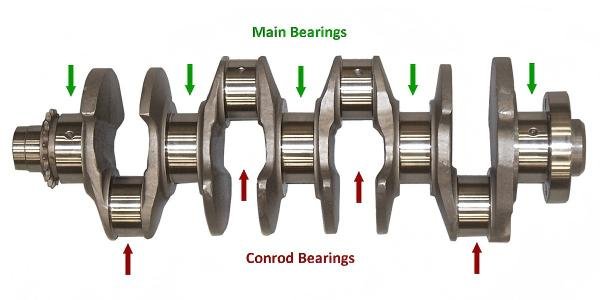
While “crankshaft bearing” often refers specifically to main and rod bearings in an engine, bearings in general can be categorized into four major types based on their internal geometry and operating principles:
2.1 Plain (Journal) Bearings
Design: Consist of a plain, smooth surface that the journal rides against.
Operation: Rely on a thin film of lubricating oil to separate moving surfaces, generating hydrodynamic pressure that keeps metal-to-metal contact at bay.
Applications: Most common in crankshaft main and rod bearings due to their ability to handle high radial loads and conform to slight misalignments.
2.2 Ball Bearings
Design: Utilize spherical rolling elements positioned between inner and outer raceways.
Operation: Roll rather than slide, resulting in lower friction coefficients—ideal for high-speed, low-to-moderate load scenarios.
Applications: Found in accessory drives, alternators, and some light-duty pump shafts.
2.3 Roller Bearings
Design: Use cylindrical, tapered, or needle rollers instead of balls.
Operation: Provide larger contact area, making them suitable for higher radial loads.
Applications: Employed in heavy-duty transmissions, differential carriers, and certain high-performance crankshafts.
2.4 Thrust Bearings
Design: Feature flat or grooved surfaces that accommodate axial (thrust) loads.
Operation: Work in conjunction with journal bearings to maintain crankshaft end-float control.
Applications: Control axial movement of the crankshaft in inline engines and some V-configurations.
Understanding these bearing types helps you appreciate why plain bearings dominate in crankshaft applications: they combine excellent load capacity with cost-effectiveness and reliability. BYWB Bearing’s plain crankshaft bearings are manufactured from premium alloys and designed for optimal hydrodynamic performance, ensuring durability under both stock and high-performance conditions.
3. What Do Crankshaft Bearings Do?

Crankshaft bearings perform several essential functions that are vital to engine operation:
3.1 Support the Crankshaft
By forming a precisely matched interface with the crankshaft journals, bearings hold the crankshaft in proper alignment inside the engine block. This support prevents undue deflection or bending under combustion pressures and mechanical forces.
3.2 Reduce Friction
The oil film between the bearing surfaces and journals drastically reduces metal-to-metal contact. This hydrodynamic lubrication minimizes energy losses and prevents heat buildup that would otherwise lead to rapid wear or seizure.
3.3 Manage Thermal Expansion
Engines operate across wide temperature ranges. Bearings accommodate slight changes in journal and block dimensions due to thermal expansion, maintaining a consistent oil film thickness for reliable lubrication.
3.4 Dampen Vibrations and Noise
The elasticity of bearing materials helps absorb minor vibrations generated by piston movements and combustion pulses, contributing to smoother engine operation and reduced noise.
3.5 Distribute Oil and Contaminants
Modern crankshaft bearings incorporate oil grooves and holes that channel pressurized oil from the crankcase to the bearing surface, ensuring continuous lubrication. These passages also help “flush” small particles away from critical contact areas, extending both bearing and crankshaft life.
By fulfilling these roles, crankshaft bearings serve as the unsung heroes in preventing catastrophic engine failure. Investing in high-quality bearings from BYWB Bearing allows you to trust that your engine’s heart will keep beating reliably mile after mile.
4. How Do You Know If Your Crankshaft Bearings Are Bad?
Detecting early signs of bearing deterioration can save you from expensive engine repairs down the line. Here are common symptoms and diagnostic methods:
4.1 Engine Knocking or Tapping Noise
A distinct knocking sound—often referred to as “rod knock”—typically indicates excessive clearance between the rod bearing and journal. This noise becomes more pronounced under load or during acceleration.
4.2 Low Oil Pressure
Worn bearings increase the oil clearance, resulting in a drop in oil pressure. If your gauge shows pressure below the manufacturer’s specification, and the oil pump is functioning correctly, bearings could be the culprit.
4.3 Metal Shavings in Oil Pan or Filter
During oil changes, inspect the oil pan and filter for metallic particles. Presence of copper or aluminum flakes suggests bearing material is eroding.
4.4 Engine Vibration or Rough Idle
Excess bearing clearance allows the crankshaft to move unpredictably, causing vibrations that you can feel at the steering wheel or through the cabin.
4.5 Visual Inspection After Disassembly
For a definitive diagnosis, mechanics remove the oil pan and bearing caps to inspect bearing surfaces. Look for:
Scoring or Scratches: Longitudinal marks indicate abrasive damage.
Discoloration: Blue or black areas signify heat spots from oil starvation.
Fatigue Cracks: Small cracks at the bearing edges point to material fatigue.
4.6 Oil Analysis
Advanced oil analysis can detect elevated levels of copper, lead, or aluminum—elements commonly found in bearing overlays. A trend of rising metal concentrations over multiple samples suggests progressive wear.
Recognizing these warning signs early—and replacing worn bearings with quality BYWB Bearing crankshaft bearings—helps prevent total engine failure, saving both time and money in the long run.
Conclusion
Crankshaft bearings may seem like small and simple parts, but their impact on engine performance, efficiency, and longevity is enormous. From understanding the basic design and materials to recognizing the different bearing types and diagnosing wear, this guide equips you with the knowledge needed to maintain and optimize your engine’s health.
At BYWB Bearing (bywbbearing.com), we specialize in manufacturing and supplying premium crankshaft bearings that meet or exceed OEM specifications. Whether you’re rebuilding a classic engine, upgrading a high-performance ride, or maintaining a commercial fleet, our bearings deliver the reliability and durability you demand. Visit our website to explore our full range of crankshaft bearings and technical resources, or contact our expert team for personalized assistance. Keep your engine running smoother, quieter, and stronger with BYWB Bearing—where quality meets precision.

6人评论了“Comprehensive Guide for Crankshaft Bearings”
Bookmarking this. As someone who designs engine accessories, I always found it frustrating how little documentation exists on the bearing-to-journal interface beyond basic textbook diagrams. The four-type comparison (plain vs. ball vs. roller vs. thrust) with specific application reasoning is exactly the kind of practical reference our industry needs. We’ve since moved some of our supplier vetting to based on their material specs page — glad the same level of detail is in their content too. We discuss similar topics at bywbbearing.com
This is exactly what I was looking for. This blog is a great resource. Visit bywbbearing.com
Really helpful crankshaft bearing guide. The main vs. rod bearing explanation and the warning signs (knocking, low oil pressure, metal in the oil pan) are pure gold for diagnostics. Thanks for sharing! — thanks for sharing. bywbbearing.com
Well said! Excellent guide on crankshaft bearings — the breakdown of the four types (plain, ball, roller, thrust) finally made it clear why plain journal bearings dominate crankshaft applications. The “symptoms of wear” section was spot-on; rod knock plus a drop in oil pressure is exactly what tipped me off during my last engine rebuild. Great resource for anyone trying to keep an engine running smooth. — we covered this at bywbbearing.com
This is exactly what I was looking for. this crankshaft bearing article is a great resource. Visit bywbbearing.com
Nice article, keep it up!Really helpful crankshaft bearing guide. The main vs. rod bearing explanation and the warning signs (knocking, low oil pressure, metal in the oil pan) are pure gold for diagnostics. Thanks for sharing! more info at bywbbearing.com