
The role of bearings cannot be overstated in industries where precision, reliability, and efficiency are a must. Bearings are the most important component in many machines and industrial systems, helping reduce friction between moving parts, improve efficiency, and extend equipment life. However, not all bearings are created equal.
Some applications require special dimensions, materials, or unique properties that standard bearings can’t provide. In these cases, customized bearings become the go-to solution.
Let us walk you through the process of designing customized bearings, while showcasing why BYWB stands out as the preferred supplier.
Custom Bearings

Custom bearings are specifically designed to meet the requirements of non-standard applications. These bearings differ in size, shape, materials, or functionality from mass-produced, off-the-shelf bearings. The need for such bearings arises when the machinery demands a unique solution that conventional bearings cannot offer.
Custom Bearing Industrial Applications
When working with bearings, it’s advisable to avoid altering the standard dimensions, as the balance between the outer race, inner ring, and rolling elements has been perfected over centuries. The established design ensures optimal speed, load capacity, and longevity.
For some applications, however, modifying standard bearings may be necessary to meet specific conditions or improve performance and lifespan.
Here we have mentioned a few modifications that can be done in custom bearing applications:
Internal radial clearance: One of the most common modifications involves adjusting the internal radial clearance, which can be fine-tuned for the designer’s needs for proper fit and function.
Number of ball bearings: Another common customization involves changing the size and number of balls in the bearing. This adjustment can help either increase the load-bearing capacity or boost speed, depending on the direction of the modification.
Lubrication: Lubrication also plays a critical role in the bearing’s performance. Choosing the right lubrication can greatly extend its lifespan and efficiency by ensuring an oil film is present between all rolling or sliding surfaces. It’s important to carefully research the most appropriate lubrication for your specific application, as speed ratings can fluctuate by 25-50% based on the lubrication chosen.
Design adjustments: Other custom design features may include adjustments to the raceway curvature, ball size and material, ring material, and even ring design. Flanges and extended inner rings can also be incorporated to meet specific design requirements.
Custom Bearing Design Process
When designing custom bearings, it’s important to note that standard bearing dimensions have been refined over time, with manufacturers providing authentic parts for load capacity and speed.
Wherever it is convenient, we recommend you to use a standard bearing, as it allows for cost savings due to the economies of scale in production.
For example, in the 6200 series, the 6203 bearing, with dimensions of 17mmx40mmx12mm, is widely manufactured and used across various applications, making it an affordable option. If your design allows, opting for this size over a slightly smaller 6202 bearing (15mmx35mmx11mm) will be more economical.
But, if your design requires customized changings, then this is the whole process that goes like:
Sample and Drawing Required
To kick off the custom design process, it’s essential to provide detailed specifications or sample bearings that the supplier can work from.
They typically require:
- Dimensions
- Material Requirements
- Load Capacity
- Environmental Factors
Prototype Drawing Design
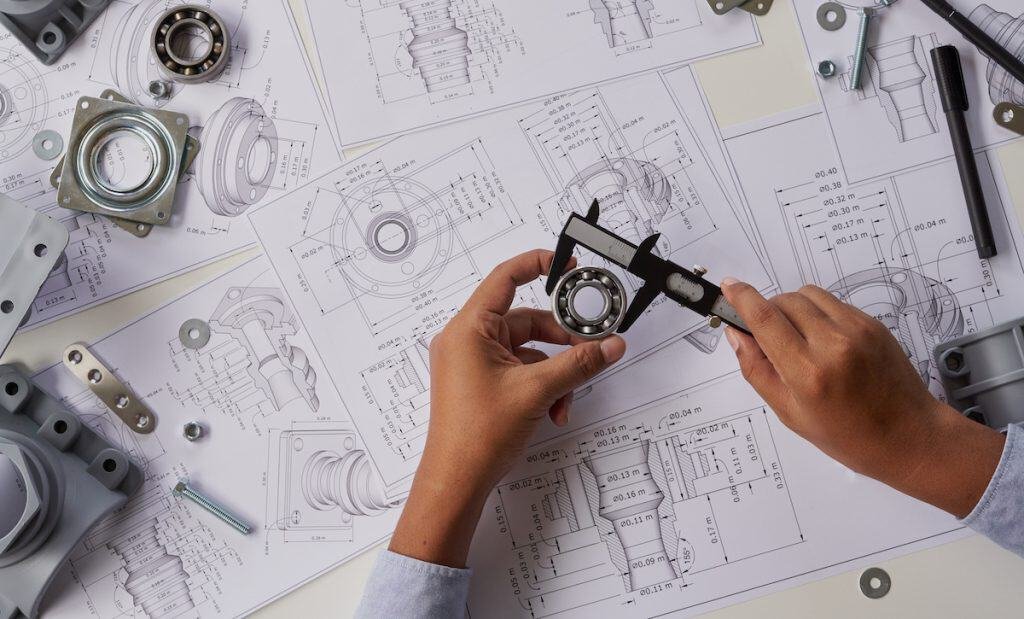
Once the design requirements are clear, a prototype drawing is produced. This is a critical phase where the design takes shape on paper (or in CAD software).
The prototype drawing includes:
- Dimensional Tolerances
- Material specifications
- Lubrication Needs
- Seal Type
OE Sample Approval
After the prototype drawing is finalized, BYWB produces an OE (Original Equipment) sample for testing and approval. This is where the design moves from theory to reality.
The OE sample undergoes:
- Performance testing
- Fit testing
- Durability assessments
Mass Production and Inspection
Once the OE sample meets all the client’s criteria, it’s approved for mass production. Each batch of bearings is inspected for:
- Dimensional accuracy
- Material consistency
- Load-bearing capacity
Shipping
When production is complete, the bearings are carefully packaged and shipped to the client. BYWB uses durable packaging materials to protect the bearings during transit, ensuring they arrive safely, ready for immediate use.
Custom Bearing Sizes and Materials
It is possible to design custom bearings that use a hybrid design, with the rings usually being made of either AISI 52100 chrome steel or stainless steel 440C. Ceramic balls are used along with these standard ring materials. In addition to being no or little lubricated, hybrid bearings are lighter in weight and have a higher speed. Hybrid bearings are most commonly used in machine tool spindles.
Examples of Custom Bearings
We have curated a list of a few examples of custom bearings, their types, and usages. Have a look below to have a clear picture.
Spherical and Plain Bearings
They are commonly used in automobiles and other equipment for smaller sizes. It can transmit radial and axial forces, as well as rotate freely. There is no bending moment on its shaft. For this example, two components are made from hard steel on high-grade steel; for other applications, one is made from bearing bronze.
Split Bearings
The most common reason for using a split bearing is to simplify the replacement of its predecessor after its service life expires. In most cases, cylindrical roller bearings are split and are used in applications where the shaft has a shoulder on one side and another component, like a gear or coupling, on the other. The smaller split bearings are found on caster rolls. Alternatively, larger size split bearings are used as “center support” bearings on shafts exceeding 600mm.
Combined Radial / Thrust Bearings
In these bearings, one race can perform both radial and thrust functions due to limited space. Radial and thrust capacities of each bearing part need to be optimized based on load and shaft speed for long-term service.
Self-Aligning Cylindrical Bearings
A conventional cylindrical roller bearing has a spherical bore fitted inside an outer sleeve, eliminating adverse effects of misalignment in self-aligning cylindrical bearings.
Ladder Bearings
Bearings of this type are designed to allow limited axial movement during thermal expansion or repositioning. Generally, ladder bearings are used at the four corners of one machine to provide balance.
Notched Deep Groove Ball Bearings
Modified deep groove ball bearings are used in applications where the shaft fit is not practical to prevent the Inner Race turning and galling the shaft during mounting and dismounting. In order to facilitate assembly and removal of the inner race, the shaft fit has been adjusted.
Extra Large Bearings
If a bearing is needed for a piece of equipment that doesn’t have a standard size, the equipment manufacturer will work with a bearing manufacturer to customize it. These bearings can all be made extra large.
Crossed Roller Bearings
With this bearing, users get a single bearing that can handle radial, thrust, and moment loads. Crossed roller bearings, or “X” bearings, are traditionally used for replacing two radial bearings and a thrust bearing.
Track Wheel Bearings
In track wheel and conveyor roll bearings, the outer race acts as the wheel. In this way, the “wheel” can withstand heavy loads. There are one or two outside flanges on track wheel bearings that follow rail edges, unlike conveyor roll bearings.
Ball Bushing Bearings
These bearings allow rotation and free axial movement while accommodating light radial loads. These versions are used in stamping presses to align dies precisely. They can also be used to allow two axes of alignment to be maintained while one part slides.
Extremely High Temperature Bearings
This type of bearing tolerates very high temperatures, up to 1200°F, with rollers made of heat-resistant tool steel. At such high temperatures, there are no suitable lubricants. For temperatures below 400°F. special heat-treating processes are used, along with various stainless steel alloys.
Eccentric Outer Race Bearings
With this special feature, bearing outer races can be rotated in their housings to adjust radial clearance. Roll Neck bearings are usually used with parallel roll bodies to create a precise radial gap.
Hybrid Bearing Ceramic Balls
To design the best solution for your application, you will usually start with a standard bearing. But, the good thing is that you can add or change elements later as well. By specifying ceramic balls, standard bearings can be improved to increase their speed ratings by 10%. And that’s why they are called Hybrid bearing ceramic balls.
It is possible to achieve an additional 10% improvement when the precision rating is increased. A common technique for increasing the speed rating of machine tool bearings is to increase the precision from ABEC 7 to ABEC 9.
BYWB Custom Bearing Size Chart
We’ve mentioned dimensions for custom bearings, you can have a look down there:
| Bearing No. | Dimension | Application | Client name | ||
| ID(mm) | OD(mm) | Width(mm) | |||
| AB12305S01 | 12 | 34 | 10 | Paper cutting Machine | DAESUNG |
| W6908 | 40 | 64 | 12 | Motorcycle | CF RACING |
| GE16KC1 | 16 | 32 | 15 | ||
| 25-1628-HP | 44 | 72.08 | 33.1 | ATV | MT DISTRIBUTORS |
| 25-1751-HP | 37 | 68 | 18.50 | ||
| 6004-2RK | 20 | 42 | 12 | Snowmobile | PRINCESS AUTO |
| 6205-2RK | 25 | 52 | 15 | ||
| 04-6004-XX(10 pack) | 20 | 42 | 12 | ||
| 04-6205-XX(10 pack) | 25 | 52 | 15 | ||
| MR105K | 5 | 10 | 3 | Tattoo Machine | Stigma |
Why Choose BYWB for Customized Bearings?
When we talk about custom bearing design and manufacturing, BYWB stands tall for its expertise, robust quality, and ability to meet unique customer requirements.
Here’s why you should consider BYWB for your customized bearings:
- Expert Engineering
- Advanced Manufacturing
- Quality Assurance
- Customization Flexibility
- Expected life
- Lubrication fill amount
- Maintenance requirements
- Provide solutions tailored to specific needs
Final Words
Custom bearings are an invaluable solution for industries that demand tailored performance and reliability. From the initial design phase to mass production, each step in the custom bearing process proper attention ensures the final product is perfectly suited to its application.
BYWB provides a complete custom bearing solution that meets the highest industry standards. So, if you’re looking for one, then get in touch with BYWB today for custom bearing solutions that will enhance your machinery’s performance.
