
Introduction
Electric motor bearings play a critical role in ensuring efficient, reliable operation of motors across various industrial and commercial applications. At BYWB Bearing, we understand that selecting the right bearing and maintaining it properly can significantly extend motor life, reduce downtime, and optimize performance. In this comprehensive guide, we will explore: 1) what electric motor bearings are, 2) the different types available, 3) grading standards, 4) how to detect bearing failure, 5) replacement costs, 6) size charts, and 7) final recommendations. Whether you’re an engineer, procurement manager, or maintenance professional, this article will equip you with the knowledge to make informed decisions.
What Are Electric Motor Bearings?

Electric motor bearings are precision-engineered components that facilitate smooth rotation of the motor shaft by reducing friction between moving parts. They support radial and axial loads, maintain shaft alignment, and absorb vibrations to ensure steady operation. Bearings typically consist of an inner ring, outer ring, rolling elements (balls or rollers), and a cage that maintains spacing. Properly selected and maintained bearings minimize energy loss, lower heat generation, and extend the service life of the motor.
Key Functions of Electric Motor Bearings
Load Support: Carry radial and axial loads generated during motor operation.
Friction Reduction: Use rolling elements to minimize sliding friction between the shaft and housing.
Vibration Dampening: Absorb and mitigate vibrations to protect motor components.
Alignment: Keep the shaft centered within the motor housing for consistent performance.
Types of Electric Motor Bearings

Selecting the correct bearing type is crucial for meeting performance requirements. Below are the most common categories used in electric motors:
1. Deep Groove Ball Bearings
Deep groove ball bearings are versatile and accommodate radial loads and moderate axial loads in both directions. They feature uninterrupted raceway grooves and a simple design, making them cost-effective and widely used in small to medium-sized motors.
2. Angular Contact Ball Bearings
Designed to support combined radial and axial loads, angular contact ball bearings have raceway grooves separated by a contact angle. They are ideal for high-speed applications where axial loads are significant, such as in pump and compressor motors.
3. Cylindrical Roller Bearings
These bearings use cylindrical rollers to handle high radial loads. Different cage designs allow for varying degrees of axial displacement, making them suitable for large motors and applications with thermal expansion.
4. Spherical Roller Bearings
Featuring two rows of rollers and a common spherical outer raceway, spherical roller bearings can accommodate misalignment and heavy radial and axial loads. They are preferred in harsh industrial environments.
5. Thrust Bearings
Thrust ball and roller bearings are specialized to handle axial loads only. Typically used in motors where end loads are prominent, such as vertical shaft applications.
6. Self-Aligning Bearings
These bearings automatically correct shaft misalignment due to mounting errors or deflections. They combine spherical rollers with an outer ring raceway that matches the roller curvature.
Electric Motor Bearings Grade Level
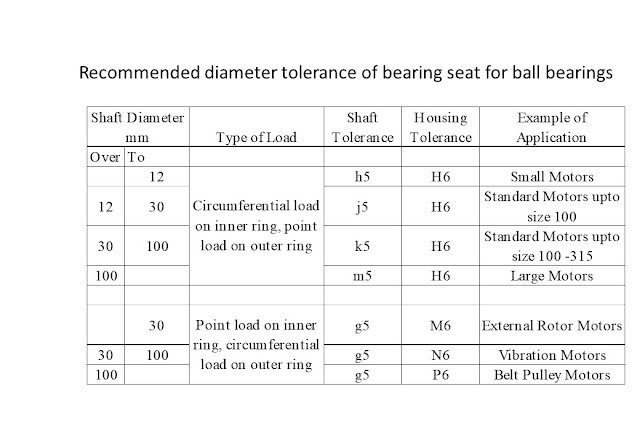
Bearings are manufactured and classified according to strict tolerances and performance characteristics. Understanding these technical specifications ensures optimal selection for your electric motor application.
ISO and ABEC Tolerance Classes
ISO Tolerance Grades (G): Defined in ISO 492 and ISO 5753, ranging from G0 (standard) to G3 (ultra-precision). Common grades:
G0 / P0: General-purpose, radial clearance C0 (standard clearance)
G1 / P6: Tighter radial/axial tolerances, suitable for moderate-speed applications
G2 / P5: High-precision for high-speed and low-vibration requirements
G3 / P4: Ultra-precision for specialized motors (e.g., servo, spindle)
ABEC Ratings: Annular Bearing Engineering Committee scale (ABEC 1, 3, 5, 7, 9). Higher ABEC = tighter geometry tolerances, better running accuracy.
Radial and Axial Clearance Classes
Radial internal clearance (RIC) affects heat generation and lifespan:
C2: Reduced clearance for high-speed precision
C0: Standard clearance for general applications
C3: Increased clearance for higher thermal expansion or contamination tolerance
C4/C5: Large clearances for heavy-duty or thermal cycling environments
Axial clearance influences thrust load capacity and endplay:
TN/A, TN/B: Controlled axial play for angular contact and thrust bearings
Surface Finish and Roundness
Raceway Roughness (Ra): Typically ≤0.2 µm for high-precision bearings; lower Ra improves lubricant film formation.
Roundness Deviation: Must be <1 µm for G2-grade bearings; affects vibration and noise.
Material and Heat Treatment
Bearing Steel Grades: Chrome steel (AISI 52100) for general duty; high-carbon, high-chromium alloys.
Through-Hardened vs. Case-Hardened:
Through-Hardened (HRC 61–65): Uniform hardness throughout cross-section for shock resistance.
Case-Hardened (Case 58–62 / Core 40–50): Hard outer layer for wear resistance, tough core for shock absorption.
Noise and Vibration Specifications
Noise Level (dB): Measured per ISO 15242; G2 bearings typically ≤15 dB(A), G0 ≤18 dB(A).
Vibration Rating: Measured via acceleration amplitude; Class A (ultra-low), B (low), C (standard).
Dynamic and Static Load Ratings
Dynamic Load Rating (C): Maximum radial load bearing can endure for 1 million revolutions at rated clearance.
Static Load Rating (C0): Maximum load before permanent deformation; crucial for start-stop applications.
Thermal Behavior and Speed Ratings
Limiting Speeds:
Grease-Lubricated: Up to 80% of oil-mist speed.
Oil-Lubricated or Oil-Mist: At or above catalogue reference speed.
Temperature Range: Typical operating range –30 °C to +150 °C; special greases allow up to +200 °C.
Fit and Mounting Tolerances
Shaft Fit (h6, h7): Controls interference or transition fit to ensure correct preload and minimize slippage.
Housing Fit (H7, J7): Maintains outer ring stability, prevents creeping under load.
By carefully matching these technical criteria—tolerance grade, clearance class, material properties, noise/vibration ratings, and fit tolerances—you can ensure the electric motor bearing you select will meet your application’s demands for precision, longevity, and reliability.
How Do I Know if My Motor Bearings Are Bad?
Detecting early signs of bearing failure can prevent catastrophic motor damage. Common indicators include:
Unusual Noise: Grinding, whining, or rumbling sounds during operation.
Increased Vibration: Elevated vibration levels detected by handheld sensors or vibration monitoring systems.
Temperature Rise: Abnormal bearing or housing temperature detected with infrared thermography.
Lubricant Leakage: Grease or oil seeping from bearing seals.
Visual Wear: Corrosion, pitting, or discoloration on bearing surfaces.
Electrical Discharge Damage: Fluting patterns on raceways due to bearing currents in variable frequency drives.
Regular maintenance and condition monitoring, such as vibration analysis and oil sampling, help identify bearing issues before they lead to motor failure.
How Much Does It Cost to Replace the Bearings on an Electric Motor?
Replacement costs vary based on motor size, bearing type, and labor rates. Below is an estimated cost breakdown:
Bearing Unit: $20 to $500 (depending on type, size, and grade).
Labor: $50 to $150 per hour; typical replacement takes 1–2 hours.
Additional Parts: Seals, gaskets, or lubricants ($5 to $50).
Example Cost Estimation
| Bearing Type | Unit Cost | Labor Time | Labor Cost | Total Estimated Cost |
| Deep Groove Ball | $20–50 | 1 hour | $50 | $70–100 |
| Angular Contact Ball | $50–100 | 1.5 hours | $75 | $125–175 |
| Spherical Roller | $150–300 | 2 hours | $100 | $250–400 |
Labor costs may vary by region and facility. Always request a detailed quote from a certified technician.
Motor Bearing Size Chart
Below is a reference chart for common motor bearing series and their bore diameters. For precise dimensions, consult the bearing manufacturer’s catalogue or BYWB Bearing’s technical datasheets.
| Series | Bore Diameter (mm) | Outer Diameter (mm) | Width (mm) |
| 6000 | 10 | 26 | 8 |
| 6200 | 10–30 | 30–60 | 9–16 |
| 6300 | 10–30 | 35–65 | 11–19 |
| 6316 | 80 | 140 | 18 |
| 6203 | 17 | 40 | 12 |
Note: Dimensions listed are typical; always verify against official datasheets.
Conclusion
Electric motor bearings are vital components that directly impact the efficiency, reliability, and longevity of motors. Understanding the different bearing types, grade levels, and maintenance practices empowers you to select the right solution for your application. Regular monitoring for noise, vibration, and temperature changes can help detect issues early and reduce downtime. While replacement costs depend on bearing type and labor, investing in quality bearings and professional installation ensures optimal motor performance.
At BYWB Bearing, we offer a comprehensive range of electric motor bearings, from deep groove ball bearings to specialized spherical and thrust designs. Our technical team provides expert guidance on selection, grading, and maintenance to help you achieve maximum uptime and cost-effectiveness. Contact us today to explore our bearing solutions tailored for your electric motors.
