
Type “China bearing manufacturer” into Google and you’ll get millions of results. Type the same phrase into Alibaba and you’ll get tens of thousands of suppliers, all claiming to be factories, all showing the same stock photos of spotless production lines, all promising “high quality, low price, fast delivery.”
Some of them are excellent. Some are trading companies posing as factories. A few will ship you bearings that look right, fit right, and fail in six months because the steel wasn’t what the certificate claimed.
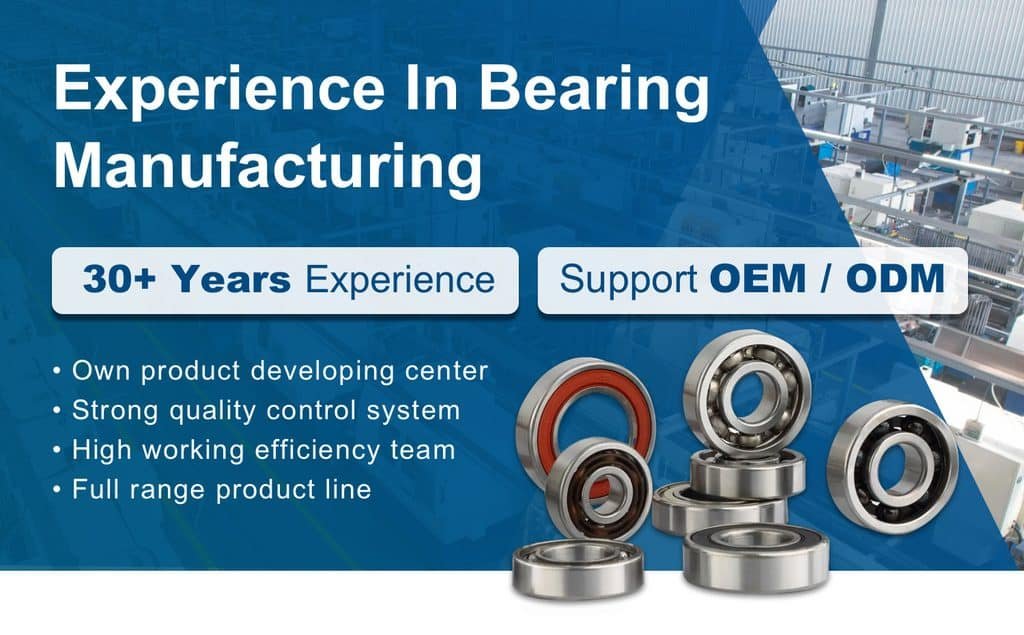
We’ve been on the manufacturing side of this industry since 1999 — 120 workers, our own turning, grinding, heat treatment and assembly lines, exporting to distributors and aftermarket brands in North America and Europe. This guide is the checklist we’d use if we were on your side of the table. It’s written for OEM purchasing managers, wholesale distributors, and brand owners placing their first serious orders with a Chinese bearing supplier.
First, Understand What You’re Actually Risking
The popular fear about Chinese bearings is counterfeiting — fake SKF or FAG boxes. That’s a real problem, but it’s not your problem. You’re sourcing unbranded or own-brand bearings for OEM production or wholesale distribution. Your risks are different:
- Material substitution. GCr15 chrome steel swapped for a cheaper grade. The bearing passes a visual inspection, the hardness test is borderline, and fatigue life drops by half.
- Skipped process steps. Heat treatment and grinding are where bearing life is made. A factory under price pressure may shorten cycle times or relax grinding tolerances on “good enough” orders.
- Inconsistent batches. Sample order is perfect; the third container is not. This is the single most common complaint we hear from buyers who switched to us from other suppliers.
- The disappearing supplier. Quoted fast, shipped slow, and went quiet the moment you reported a quality claim.
Notice that none of these risks are visible in a price quote. That’s the point. Everything below is about making them visible before you wire the deposit.
Trading Company or Real Manufacturer? How to Tell in 15 Minutes
There’s nothing inherently wrong with trading companies — a good one adds value in consolidation and logistics. But you deserve to know which one you’re talking to, because the vetting process is completely different. Here’s how to tell quickly:
Ask for a live video call from the production floor. Not a factory tour video — a live call, today, walking from raw material storage to the grinding workshop to the assembly line. A manufacturer says “give me twenty minutes.” A trading company says “let me arrange with the factory and get back to you next week.”
Check the business license. Ask for a copy of the Chinese business license (营业执照). Look at the registered business scope: 生产 (production/manufacturing) vs. 销售 (sales/trading). The registered capital and founding date are also on this document — if the “factory” was founded eighteen months ago, you know something important.
Ask a technical question only a factory can answer. For example: “What’s your heat treatment process for GCr15, and what’s your standard hardness range after quenching and tempering?” A manufacturer’s engineer answers immediately — for the record, the answer should involve through-hardening to roughly HRC 58–64. A trader forwards your question and replies two days later with a brochure paragraph.
Look at the product range. A real bearing factory has a defined range built around its equipment — deep groove ball bearings, wheel hub units, agricultural bearings, whatever its lines produce. A supplier offering every bearing type ever catalogued, plus chains, sprockets and hydraulic fittings, is a trader.
The 7-Point Supplier Checklist
Once you’ve confirmed you’re talking to a manufacturer, run this checklist. Serious suppliers will answer every point without hesitation; hesitation is itself data.
1. Certifications — verified, not claimed
ISO 9001 is table stakes. IATF 16949 matters if you’re supplying automotive OEMs. But don’t collect PDF certificates and file them — verify the certificate number on the issuing body’s website, and confirm the certified scope actually covers bearing manufacturing at that factory address. We wrote a full breakdown of bearing quality standards like ISO 9001 and IATF 16949 if you want the details.
2. Process control, not just final inspection
Ask how quality is controlled inside the process: grinding dimension control, roundness and roughness checks, hardness sampling per heat treatment batch, noise and clearance testing on assembled bearings. A factory that only talks about “100% final inspection” is telling you defects are made and then sorted out, not prevented.
3. Material traceability
Can they trace a shipped batch back to the steel supplier’s mill certificate? Ask for a sample traceability record. If the answer is vague, the steel question mark from earlier in this article applies to your order.
4. Testing capability
Minimum for a credible bearing factory: hardness testers, roundness/profile instruments, roughness testers, clearance gauges, and bearing noise/vibration testers (BVT or equivalent). Life testing rigs are a strong bonus. Ask for photos with date stamps, or better, see them live on that video call.
5. MOQ and flexibility
This is where factory structure matters in your favor. Large state-scale factories won’t look at orders below container quantities. Small workshops take anything but can’t hold tolerances consistently. The sweet spot for most aftermarket brands and regional distributors is a mid-size factory — around 100–150 workers — that can run both standard catalog items and low-MOQ custom work: special dimensions, non-standard seals, private-label packaging, kit assembly.
6. Communication speed and quality
Time how long technical questions take to come back, and whether the answer actually answers the question. Your contact’s English matters less than their access to engineering. A salesperson who can pull an engineer onto a call the same day is worth more than a fluent salesperson reading from a catalog.
7. Export track record in your market
Ask for references or at least evidence of shipments to your region — not customer names (confidentiality is fair), but markets served, typical products, years of export history. A supplier shipping powersports wheel bearing kits to North America for years understands your labeling, packaging and documentation expectations in a way a domestic-focused factory doesn’t.
The Questions That Separate Professionals from Gamblers
Before your first order, ask these directly:
- “What steel grade do you use, and can you provide the mill certificate with each batch?”
- “What is your hardness range after heat treatment, and how do you verify it?”
- “What’s your AQL for final inspection, and what happens when a batch fails?”
- “If we report a quality issue after arrival, what is your claims process — specifically, who pays for what?”
- “Can you produce to our drawing, and what tolerances can you hold on custom dimensions?”
The content of the answers matters. But honestly, the way they answer matters more. Professional factories give numbers, ranges and procedures. Unreliable ones give adjectives.
Red Flags That Should End the Conversation
- A price dramatically below every other quote. Bearing steel, heat treatment and grinding cost roughly the same everywhere in China. A quote 30% below market is not efficiency — it’s a material or process shortcut you haven’t found yet.
- Certificates you can’t verify, or “the certificate is being renewed.”
- Refusal of third-party inspection. SGS, TÜV, BV inspections cost a few hundred dollars and any legitimate factory hosts them routinely.
- Pressure on payment terms. 100% TT in advance from a first-time customer is a hard no. Standard is 30% deposit, 70% against documents — and for later orders, negotiate better.
- No interest in your application. A supplier who never asks what the bearing is for will never flag a specification mismatch. The good ones ask about loads, speeds, environment and sealing requirements before they quote.
Structure Your Trial Order Like an Audit
Never let the first order be a big one. A sensible onboarding sequence:
- Samples — including samples of the exact production spec, not showroom samples. Test them: dimensions, hardness, noise, and ideally a bench life test or field trial in your application.
- A small pilot order — enough to reveal batch consistency, packaging quality and documentation accuracy, small enough to survive if it goes wrong.
- Third-party pre-shipment inspection on the pilot order, paid by you, non-negotiable on your side.
- Scale up gradually, with the inspection regime tapering only after several clean batches.
Any supplier confident in their product will support this sequence. One who pushes you straight to a container is telling you something.
Why the Cheapest Quote Is Usually the Most Expensive
A wheel bearing that costs you $0.40 less per piece and fails in the field costs you the bearing, the freight, the customer’s labor, the warranty handling — and the customer. In the aftermarket, your brand name is on the box, and end users don’t blame the anonymous factory. They blame you.
The buyers who build durable businesses on Chinese sourcing don’t chase the floor price. They find a factory that documents its materials, controls its process, answers technical questions with numbers, and stands behind claims — then they pay a fair price and stay for years. Total cost of a reliable supplier is almost always lower than the purchase price of a cheap one.
Frequently Asked Questions
Is it safe to buy bearings from China?
Yes — with proper vetting. China produces a huge share of the world’s bearings across every quality tier, including bearings sold under premium global brands. The safety comes from your verification process, not the country.
How do I verify a Chinese bearing factory without visiting?
Live video factory walkthrough, verified business license and certificates, technical Q&A with their engineers, sample testing, and a paid third-party inspection (SGS/TÜV/BV) on your pilot order. Combined, these five steps catch nearly every common problem.
What is a reasonable MOQ for custom bearings?
It depends on factory size and bearing type. Mid-size manufacturers typically accept custom dimensions, seals or private-label packaging from a few hundred to a few thousand pieces. If a supplier demands container quantities for a simple customization, keep looking.
Should I use a sourcing agent instead of going direct?
Agents add a margin and a layer between you and the factory’s engineers. For technical products like bearings, direct factory relationships usually win on both price and problem-solving speed — once you’ve verified the factory yourself.
What payment terms are standard?
30% deposit with order confirmation, 70% against bill of lading copy is the common baseline for new relationships. Letters of credit work for larger orders. Avoid 100% advance payment.
The Bottom Line
Choosing a China bearing manufacturer isn’t about finding the best website or the lowest quote. It’s a verification exercise: confirm they’re a real factory, confirm their materials and process control, test their product in your application, and start small. Do those things and the country-of-origin question largely disappears — you’re left with what actually matters, which is whether the bearing in the box does its job for the long haul.
If you’re sourcing deep groove ball bearings, ATV/UTV wheel bearing kits, agricultural bearings or oil seals and want a manufacturer’s straight answer on specs, MOQ or custom work, talk to us. Twenty-five years of production, our own lines from turning to assembly, and low-MOQ custom programs for aftermarket brands — we’ll answer with numbers, not adjectives.
