
When it comes to the steering and suspension systems in vehicles, two components play critical roles in ensuring smooth and safe operation—ball joints and tie rod ends. These parts are essential for maintaining stability, control, and handling of your vehicle, especially over uneven terrain or during sharp turns.
At BYWB Bearing, we specialize in producing high-quality ball joints and tie rod ends, trusted by distributors and professionals worldwide for their durability and performance. In this article, we’ll dive deep into what these parts are, how they function, and what makes them different from each other.
What Is a Ball Joint?

A ball joint is a spherical bearing that connects the control arm of a vehicle to the steering knuckle. Think of it as the “pivot point” that allows your wheels to move up and down while still enabling them to turn left and right. This part resembles the ball-and-socket joint in your shoulder—allowing for multi-directional movement.
Ball joints are typically found in the front suspension system and are crucial for maintaining the alignment and stability of the vehicle. There are usually upper and lower ball joints in vehicles with double-wishbone suspension, while strut-type suspensions may use only one.
Types of Ball Joints:
- Load-carrying ball joints: Support the vehicle’s weight.
- Follower ball joints: Allow steering movement but don’t support weight.
What Is a Tie Rod End?

A tie rod end is part of the steering system. It connects the steering rack (or steering gear) to the steering knuckle on each front wheel. Its primary role is to transmit force from the steering gear to the wheels, enabling them to turn as the driver moves the steering wheel.
Tie rod ends have a ball-and-socket structure similar to ball joints, which allows them to pivot as the suspension moves and as the wheels are steered.
Types of Tie Rod Ends:
- Inner tie rod end: Connects directly to the steering rack.
- Outer tie rod end: Connects the inner tie rod to the steering knuckle.
How Does a Ball Joint Work?
A ball joint functions as a flexible joint that allows the front wheels to move in different directions while maintaining a stable connection to the suspension. It supports vertical loads while permitting horizontal movement. This dual movement capability is essential for the wheels to follow the surface of the road while turning.
Inside a ball joint, a hardened steel ball sits inside a metal socket, lubricated to reduce friction. Over time, as vehicles are driven over bumps or take sharp turns, the ball joint absorbs these motions while keeping the wheel aligned.
Key Functions of Ball Joints:
- Allow up and down movement (to absorb road shock).
- Permit left and right rotation (for steering control).
- Maintain camber angle and toe alignment.
How Does a Tie Rod End Work?
A tie rod end transmits steering input from the driver to the wheels. When you turn the steering wheel, the steering rack pushes or pulls the inner tie rod, which in turn moves the outer tie rod end. This motion causes the steering knuckle to pivot, turning the wheels in the desired direction.
The ball-and-socket structure allows the tie rod ends to move in tandem with the vehicle’s suspension travel, ensuring that the wheels stay aligned with the steering rack throughout various terrains.
Key Functions of Tie Rod Ends:
- Convert rotational steering input into lateral wheel movement.
- Allow smooth steering while compensating for suspension travel.
- Maintain toe alignment (angle of the wheels when viewed from above).
What’s the Difference Between Ball Joints and Tie Rod Ends?
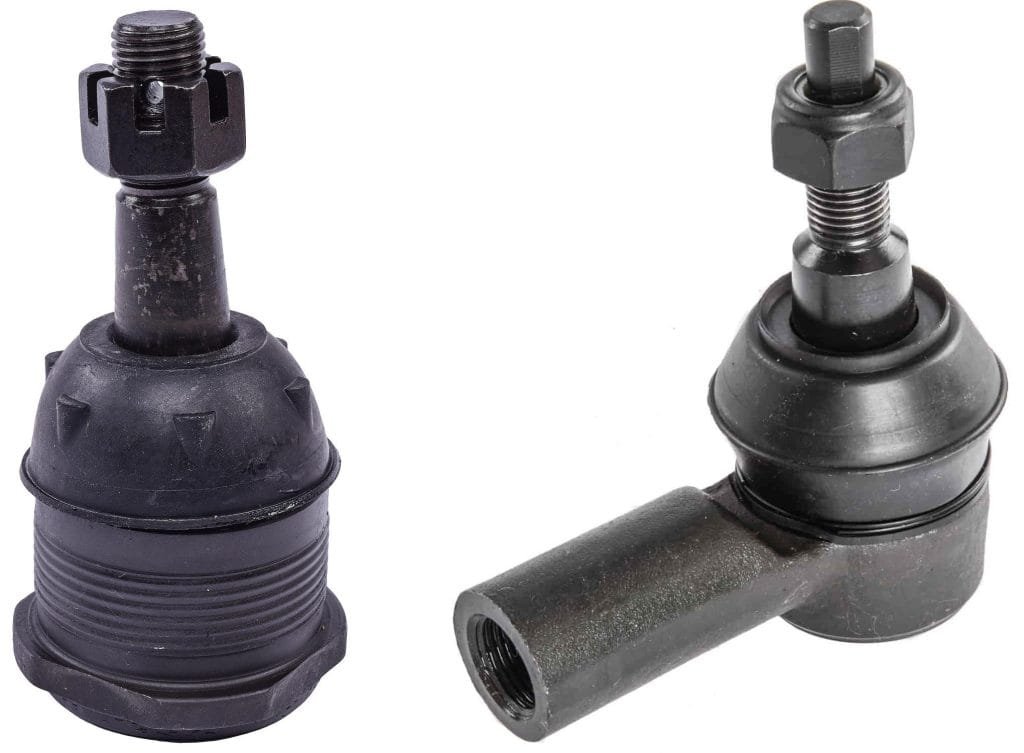
While ball joints and tie rod ends look similar and are both part of the steering and suspension system, they serve different purposes.
| Feature | Ball Joint | Tie Rod End |
| Location | Suspension system | Steering system |
| Primary Function | Connects control arm to steering knuckle | Connects steering rack to steering knuckle |
| Type of Movement | Multi-directional (vertical + horizontal) | Mainly lateral (side-to-side) |
| Load Bearing | Yes (in some cases) | No |
| Common Issues | Wear leads to loose suspension, alignment issues | Wear leads to steering play, uneven tire wear |
| Alignment Influence | Camber & caster angles | Toe angle |
Key Differences:
- Function: Ball joints support vehicle weight (if load-carrying) and allow wheel movement; tie rod ends translate steering wheel motion to wheels.
- Impact when failing: Worn ball joints can cause clunking sounds, poor handling, and tire wear; bad tie rod ends can cause loose steering, vibration, and misalignment.
Ball Joints Size Chart
| BYWB Part Number | All Balls Part Number | Fitment |
| 82-1009 | All balls 42-1009 | Honda TRX420 FA IRS 15-22, TRX420 FA Solid Axle 14-22, TRX420 FE 14-22, TRX420 FM 14-22 |
| 82-1015 | All balls 42-1015 | Ball Joint Kit – Lower Honda TRX420 FA IRS 15-22, TRX420 FA Solid Axle 14-22, TRX420 FE 14-22, TRX420 FM 14-22, TRX420 FPA Solid Axle 14, TRX420 TE 14-22 |
| 82-1026 | All balls 42-1026 | Suzuki LT-A400 2WD King Quad 08-09, LT-A400 Eiger 2wd 02-07, LT-A400F 4WD King Quad 08-22 |
| 82-1037 | All balls 42-1037 | Polaris Brutus HD,Hawkeye 300,Ranger 500 |
| 82-1026 | All balls 42-1026 | Suzuki Eiger 400,King Quad 400 |
| 82-1038 | All balls 42-1038 | Yamaha Grizzly 550,700 |
| 82-1042 | All balls 42-1042 | Can-Am Commander 1000 |
| 82-1043 | All balls 42-1043 | Yamaha Grizzly 660 |
| 82-1051 | All balls 42-1051 | Polaris RZR 4 XP 1000,RZR XP 4 1000 |
| 82-1031 | All balls 42-1031 | 2016 Polaris Phoenix 200 |
| 82-1033 | All balls 42-1033 | Kawasaki Brute Force 650 KVF650D 4×4 |
Tie Rod Ends Size chart
| BYWB Part Number | All Balls Part Number | Fitment |
| 81-1050 | All balls 51-1050 | Polaris Scrambler XP 1000 |
| 81-1027 | All balls 51-1027 | Arctic Cat 1000 4×4 MudPro Limited |
| 81-1020 | All balls 51-1020 | Polaris 300,400L,Trail Blazer 250 |
| 81-1024 | All balls 51-1024 | Kawasaki KFX700 |
| 81-1031 | All balls 51-1031 | amaha Grizzly 450 YFM450FG 4×4 |
| 81-1029 | All balls 51-1029 | Suzuki King Quad 450 LTA450X 4×4 Axi |
| 51-1051 | All balls 51-1051 | polaris,outlaw 450,525,Sportsman XP 550,850 |
| 81-1053 | All balls 51-1053 | Honda Foreman 450 TRX450ES 4×4 ES |
| 81-1001 | All balls 51-1001 | Honda FourTrax 125 TRX125 2×4 |
| 81-1003 | All balls 51-1003 | Arctic Cat 50,90,honda FourTrax 350 |
| 81-1005 | All balls 51-1005 | Honda FourTrax 250 TRX250 2×4 |
| 81-1006 | All balls 51-1006 | Honda FourTrax 250 TRX250X 2×4 |
| 81-1007 | All balls 51-1007 | yamaha Bear Tracker 250,Big Bear 250 |
| 81-1009 | All balls 51-1009 | Outlander 330 |
| 81-1029 | All balls 51-1029 | Suzuki King Quad 450 LTA450X 4×4 Axi |
| 81-1030 | All balls 51-1030 | Polaris Ranger 400,500;Brutus HD;ACE 900 |
| 81-1033 | All balls 51-1033 | Polaris Hawkeye 300 2×4 |
| Tie Rod End Kit for Polaris Sportsman 500 4×4 6×6 EFI HO X2 4×4 6×6 1998 – 2012 | ||
| 81-1021 | All balls 51-1021 | Polaris ATP 330 4X4 |
| 81-1037 | All balls 51-1037 | yamaha,Rhino 450,660,700 |
| 81-1017 | All balls 51-1017 | Arctic Cat 1000,250,200 |
| 81-1051 | All balls 51-1051 | polaris,outlaw 450,525,Sportsman XP 550 |
| 81-1023 | All balls 51-1023 | Kawasaki Brute Force 650;Suzuki Twin Peaks 700 |
| 81-1029 | All balls 51-1029 | Suzuki King Quad 450 500 750 |
| 81-1008 | All balls 51-1008 | honda400,450 |
| 81-1021 | All balls 51-1021 | polaris ATP 330,500;Diesel 455;Big Boss 500;Magnum |
| 81-1014 | All balls 51-1014 | Kawasaki KFX80;Suzuki Eiger 400;Suzuki Quadracer 250 |
| 81-1052 | All balls 51-1052 | Arctic Cat 1000 4×4 MudPro Limited |
| 81-1053 | All balls 51-1053 | Honda Foreman 450 TRX450ES 4×4 ES |
Conclusion
Both ball joints and tie rod ends are vital components that ensure your vehicle handles properly and safely. Understanding the difference between them is key for maintenance, troubleshooting, and replacement.
At BYWB Bearing, we are proud to manufacture precision-engineered ball joints and tie rod ends for a wide range of vehicles. Whether you’re a distributor, repair shop, or automotive enthusiast, our parts offer superior durability, exact fitment, and competitive pricing.