
Track roller bearings are vital components in a wide array of industrial and mechanical applications, known for their reliability, load-bearing capacity, and performance in demanding environments. Whether you’re in the field of material handling, rail transportation, packaging machinery, or automated production lines, track roller bearings play a crucial role in ensuring smooth linear motion and guiding systems. In this ultimate guide brought to you by BYWB Bearing, we will explore everything you need to know about track roller bearings: what they are, their types, uses, differences from similar components, sizing, and how to choose the right one for your needs.
1. What is a Track Roller Bearing?

Track roller bearings are rolling elements designed to run on tracks or guide rails, typically used in linear motion systems. These bearings are designed to carry heavy loads, withstand shock, and operate in tough environments with minimal maintenance. They usually consist of an inner race, outer race, rolling elements (cylindrical or needle rollers), and sealing elements to protect against contaminants.
There are two main configurations:
- Yoke-type track rollers: Mounted on shafts and supported in housings.
Stud-type track rollers (cam followers): Feature a stud or bolt that can be mounted directly onto a machine frame.
Key features of track roller bearings include:
High radial and axial load capacity
Resistance to wear and misalignment
Sealed designs for harsh environments
BYWB track roller bearings are manufactured with high-precision components and heat-treated steel to ensure durability and long service life.
2. Types of Track Roller Bearings
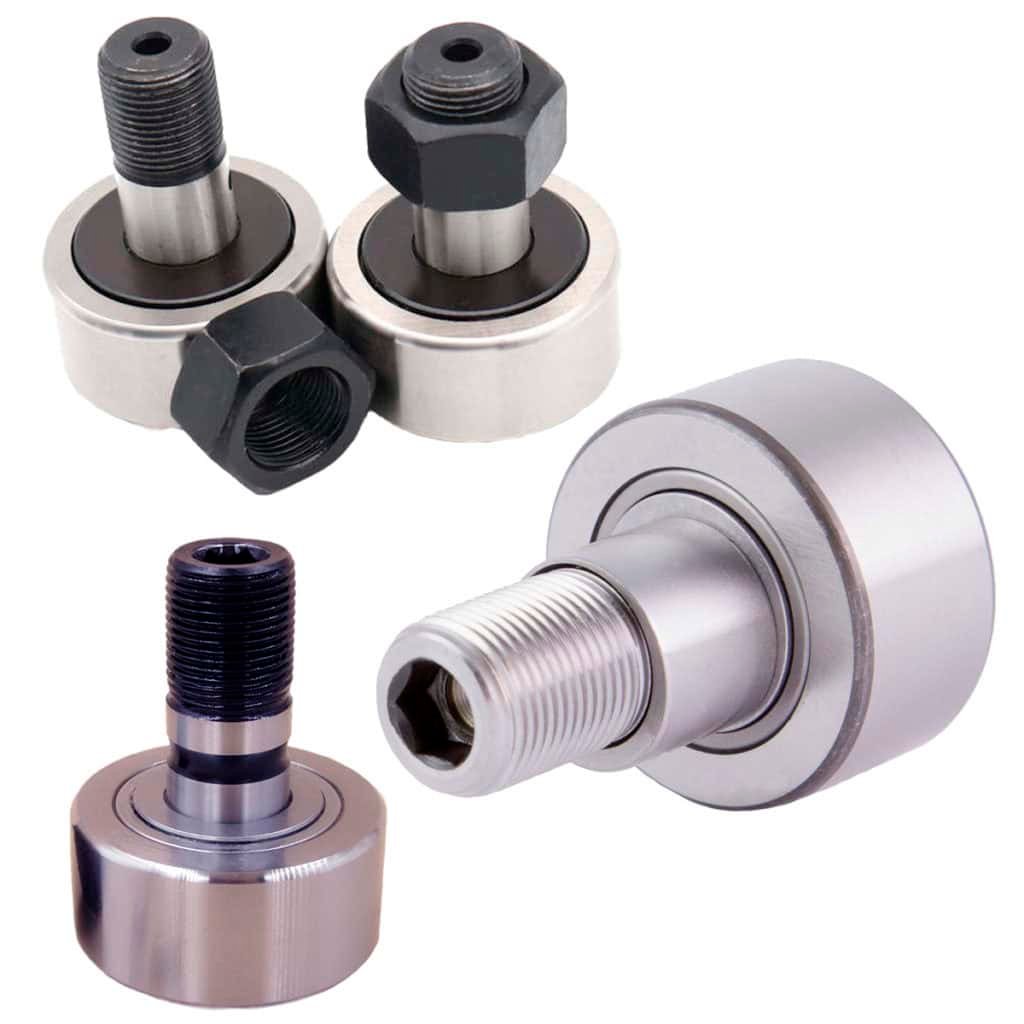
There are various types of track roller bearings depending on design, application, and load requirements. The most common types include:
A. Yoke Type Track Rollers
Mounted using a shaft or bolt
Ideal for high radial loads
Available with cylindrical or crowned outer rings
B. Stud Type Track Rollers (Cam Followers)
Integrated stud makes mounting simple
Suitable for applications with reciprocating motion
Some designs include hexagon sockets or lubrication holes
C. Full Complement Rollers
Maximize the number of rolling elements
High load capacity
More suitable for low to moderate speed applications
D. Caged Rollers
Use a cage to separate rollers
Reduced friction and wear
Suitable for high-speed applications
E. Crowned vs. Cylindrical Outer Rings
Crowned rings: Reduce edge stress and allow misalignment
Cylindrical rings: Provide more surface contact
BYWB Bearing offers a wide selection of all these types, engineered to provide optimal performance in various industrial conditions.
3. What is the Use of a Track Roller?
Track rollers are primarily used to guide or support a load along a defined path. Some of the most common uses include:
Conveyor systems: Guide and support conveyor belts
Automated machinery: Provide linear movement and support
Material handling equipment: Carry heavy loads with reduced friction
Packaging machines: Assist with fast and precise linear motion
Robotic arms: Guide movement along rails
Rail transport and elevator systems: Support and guide moving components
In addition to their versatility, track rollers from BYWB are known for their:
Excellent resistance to contamination
Long service life
Maintenance-friendly designs
4. What is the Difference Between a Cam Roller and a Track Roller?

The terms “cam roller” and “track roller” are often used interchangeably, but there are some differences worth noting:
| Feature | Cam Roller (Cam Follower) | Track Roller |
| Mounting | Comes with integrated stud | Mounted on shaft (yoke) |
| Application | Follows a cam profile or path | Guides a load along a track |
| Load Type | Radial + occasional axial | Primarily radial |
| Lubrication | Often includes built-in grease fitting | Typically lubricated externally |
At BYWB Bearing, both cam followers and track rollers are manufactured to meet international standards and customer-specific performance requirements. Understanding these differences helps engineers choose the right product for the intended mechanical design.
- Metric Track Rollers Size Chart
NUTR Track Roller Bearing Size Chart
| Part Number | Inner Diameter, d | Outer Diameter, D | Inner Ring Width, b | Outer Ring Width, B | Dynamic Capacity, Cr. | Static Capacity, Cor. | Weight |
| NUTR 15 | 15 mm | 35 mm | 19 mm | 18 mm | 23,000 N | 27,000 N | 0.218 lb |
| NUTR 1542 | 15 mm | 42 mm | 19 mm | 18 mm | 23,000 N | 27,000 N | 0.348 lb |
| NUTR 17 | 17 mm | 40 mm | 21 mm | 20 mm | 24,800 N | 31,000 N | 0.324 lb |
| NUTR 1747 | 17 mm | 47 mm | 21 mm | 20 mm | 24,800 N | 31,000 N | 0.485 lb |
| NUTR 20 | 20 mm | 47 mm | 25 mm | 24 mm | 39,000 N | 50,000 N | 0.540 lb |
| NUTR 2052 | 20 mm | 52 mm | 25 mm | 24 mm | 39,000 N | 50,000 N | 0.708 lb |
| NUTR 25 | 25 mm | 52 mm | 25 mm | 24 mm | 43,500 N | 60,000 N | 0.620 lb |
| NUTR 2562 | 25 mm | 62 mm | 25 mm | 24 mm | 43,500 N | 60,000 N | 0.992 lb |
| NUTR 30 | 30 mm | 62 mm | 29 mm | 28 mm | 59,000 N | 79,000 N | 1.025 lb |
| NUTR 3072 | 30 mm | 72 mm | 29 mm | 28 mm | 59,000 N | 79,000 N | 1.537 lb |
| NUTR 35 | 35 mm | 72 mm | 29 mm | 28 mm | 65,000 N | 93,000 N | 1.389 lb |
| NUTR 3580 | 35 mm | 80 mm | 29 mm | 28 mm | 65,000 N | 93,000 N | 1.843 lb |
| NUTR 40 | 40 mm | 80 mm | 32 mm | 30 mm | 90,000 N | 134,000 N | 1.799 lb |
| NUTR 4090 | 40 mm | 90 mm | 32 mm | 30 mm | 90,000 N | 134,000 N | 2.489 lb |
| NUTR 45 | 45 mm | 85 mm | 32 mm | 30 mm | 95,000 N | 147,000 N | 1.947 lb |
| NUTR 45100 | 45 mm | 100 mm | 32 mm | 30 mm | 95,000 N | 147,000 N | 3.078 lb |
| NUTR 50 | 50 mm | 90 mm | 32 mm | 30 mm | 100,000 N | 161,000 N | 2.095 lb |
| NUTR 50110 | 50 mm | 110 mm | 32 mm | 30 mm | 100,000 N | 161,000 N | 3.726 lb |
| NUTR 50110A | 50 mm | 110 mm | 32 mm | 40 mm | 100,000 N | 161,000 N | 4.605 lb |
KR.PP Metric Series Cam Follower size chart
| Part Number | D | S | B | L | L1 | L2 | B1 | Weight |
| KR 16 PP | 16 mm | 6 mm | 11 mm | 28 mm | 16.0 mm | 8 mm | 0.6 mm | 0.044 lb |
| KR 19 PP | 19 mm | 8 mm | 11 mm | 32 mm | 20.0 mm | 10 mm | 0.6 mm | 0.071 lb |
| KR 22 PP | 22 mm | 10 mm | 12 mm | 36 mm | 23.0 mm | 12 mm | 0.6 mm | 0.099 lb |
| KR 26 PP | 26 mm | 10 mm | 12 mm | 36 mm | 23.0 mm | 12 mm | 0.6 mm | 0.134 lb |
| KR 30 PP | 30 mm | 12 mm | 14 mm | 40 mm | 25.0 mm | 13 mm | 0.6 mm | 0.196 lb |
| KR 32 PP | 32 mm | 12 mm | 14 mm | 40 mm | 25.0 mm | 13 mm | 0.6 mm | 0.220 lb |
| KR 35 PP | 35 mm | 16 mm | 18 mm | 52 mm | 32.5 mm | 17 mm | 0.8 mm | 0.377 lb |
| KR 40 PP | 40 mm | 18 mm | 20 mm | 58 mm | 36.5 mm | 19 mm | 0.8 mm | 0.549 lb |
| KR 47 PP | 47 mm | 20 mm | 24 mm | 66 mm | 40.5 mm | 21 mm | 0.8 mm | 0.860 lb |
| KR 52 PP | 52 mm | 20 mm | 24 mm | 66 mm | 40.5 mm | 21 mm | 0.8 mm | 1.025 lb |
| KR 62 PP | 62 mm | 24 mm | 29 mm | 80 mm | 49.5 mm | 25 mm | 0.8 mm | 1.768 lb |
| KR 72 PP | 72 mm | 24 mm | 29 mm | 80 mm | 49.5 mm | 25 mm | 0.8 mm | 2.304 lb |
| KR 80 PP | 80 mm | 30 mm | 35 mm | 100 mm | 63.0 mm | 32 mm | 1.0 mm | 3.441 lb |
| KR 85 PP | 85 mm | 30 mm | 35 mm | 100 mm | 63.0 mm | 32 mm | 1.0 mm | 3.836 lb |
| KR 90 PP | 90 mm | 30 mm | 35 mm | 100 mm | 63.0 mm | 32 mm | 1.0 mm | 4.343 lb |
KRV Series Track Roller Bearing Size Chart
| Part Number | D, mm | SD, mm | B, mm | C, mm | L, mm | SL, mm | TL, mm | Dyn. Cap. N | Sta. Cap. N | Weight, lbs |
| KRV 16 | 16 | 6 | 11 | 0.6 | 28 | 16.0 | 8 | 4,850 | 6,500 | 0.044 |
| KRV 19 | 19 | 8 | 11 | 0.6 | 32 | 20.0 | 10 | 5,500 | 7,900 | 0.071 |
| KRV 22 | 22 | 10 | 12 | 0.6 | 36 | 23.0 | 12 | 6,300 | 9,100 | 0.099 |
| KRV 26 | 26 | 10 | 12 | 0.6 | 36 | 23.0 | 12 | 7,300 | 11,300 | 0.135 |
| KRV 30 | 30 | 12 | 14 | 0.6 | 40 | 25.0 | 13 | 9,500 | 14,600 | 0.196 |
| KRV 32 | 32 | 12 | 14 | 0.6 | 40 | 25.0 | 13 | 10,000 | 15,800 | 0.221 |
| KRV 35 | 35 | 16 | 18 | 0.8 | 52 | 32.5 | 17 | 12,800 | 23,000 | 0.377 |
| KRV 40 | 40 | 18 | 20 | 0.8 | 58 | 36.5 | 19 | 14,800 | 26,500 | 0.549 |
| KRV 47 | 47 | 20 | 24 | 0.8 | 66 | 40.5 | 21 | 20,600 | 42,000 | 0.860 |
| KRV 52 | 52 | 20 | 24 | 0.8 | 66 | 40.5 | 21 | 22,500 | 46,000 | 1.025 |
| KRV 62 | 62 | 24 | 29 | 0.8 | 80 | 49.5 | 25 | 34,000 | 76,000 | 1.768 |
| KRV 72 | 72 | 24 | 29 | 0.8 | 80 | 49.5 | 25 | 37,000 | 85,000 | 2.304 |
| KRV 80 | 80 | 30 | 35 | 1.0 | 100 | 63.0 | 32 | 49,500 | 120,000 | 3.442 |
| KRV 90 | 90 | 30 | 35 | 1.0 | 100 | 63.0 | 32 | 53,000 | 130,000 | 4.344 |
Note: Always refer to the latest manufacturer catalog for precise dimensions and tolerances. BYWB Bearing provides custom track roller solutions upon request.
6. Conclusion: Why Choose BYWB Track Roller Bearings?
At BYWB Bearing, we understand that performance, precision, and durability are non-negotiable in today’s competitive industrial environments. Our track roller bearings are engineered to:
Withstand high radial and axial loads
Operate efficiently in dusty, wet, or high-temperature conditions
Offer long service life with minimal maintenance
Whether you need standard NUTR series rollers or custom solutions for your machinery, BYWB is your trusted partner. Our team offers:
Global sourcing and logistics support
OEM & ODM services
Fast lead times and competitive pricing
Technical consultation and engineering support
Contact us today to discuss your track roller bearing requirements or explore our complete catalog at www.bywbbearing.com. Let BYWB help you keep your systems rolling smoothly and reliably.
BYWB Bearing – Your Precision Partner in Motion
