
What’s a vehicle without wheels? Wheels are the entities that keep your vehicle moving and stable on the road. But what makes them do that? The answer is wheel bearings.
They are tiny structures in the wheel assembly that make it possible for the wheels to turn with a lot less friction. This, in return, results in stability and good road performance. So, it’s important to have knowledge about these important bearing types so that you can take care of your vehicle better and know if the wheel bearings need replacement or not.
This is exactly what you’ll learn from this article. Let’s see what wheel bearings are, their functions, the different types of bearings, and some bad bearing symptoms.
Wheel Bearing Introduction
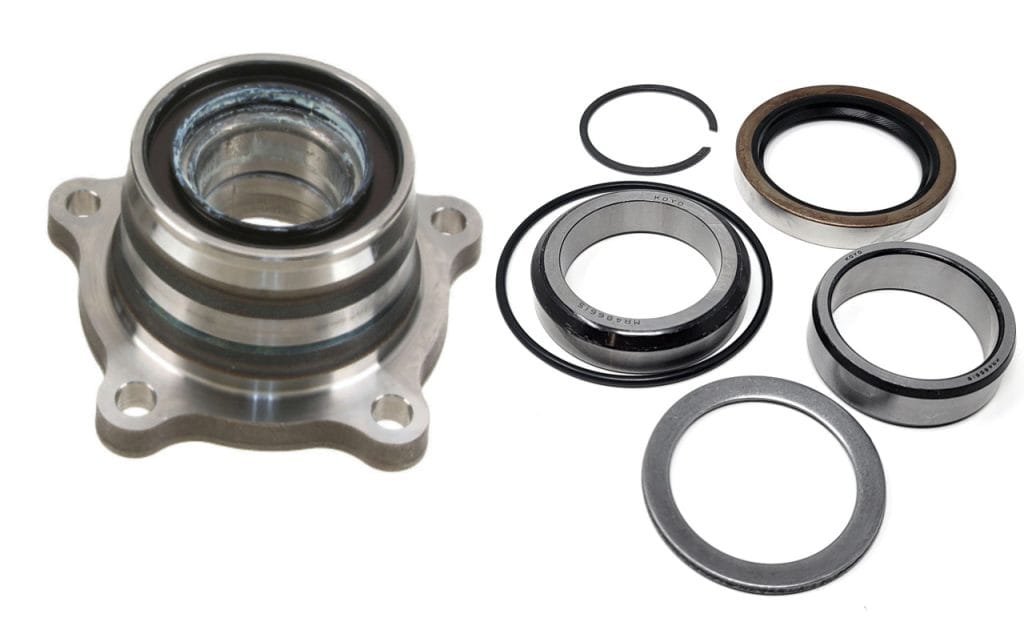
A wheel bearing is present in the wheel assembly of a vehicle to allow the wheels to rotate with very little friction. It has a set of either of the two:
- steel balls
- or rollers inside in a race (metal ring).
The wheel bearing supports the weight of a vehicle by being placed between the axle and the hub to make sure the movement is stable. These bearings perfectly support radial and axial loads without any hindrance.
Important Characteristics of Wheel Bearings
- High Durability: Wheel bearing is manufactured of hardened steel or similar materials to resist heavy pressure and wear and tear.
- Low Friction: Such a bearing lessens friction between different mobile parts for seamless wheel rotation.
- Sealed Construction: Many modern bearings are sealed which means they keep the dirt, moisture, and debris out of the vehicle but lock the bearing’s grease.
- Handle Load Perfectly: It not only tolerate heavy radial loads but also thrust loads for best performance under changing driving situations.
Now, let’s move to the types of wheel bearings. There are basically two types: ball bearings and roller bearings.
Different Types of Wheel Bearings
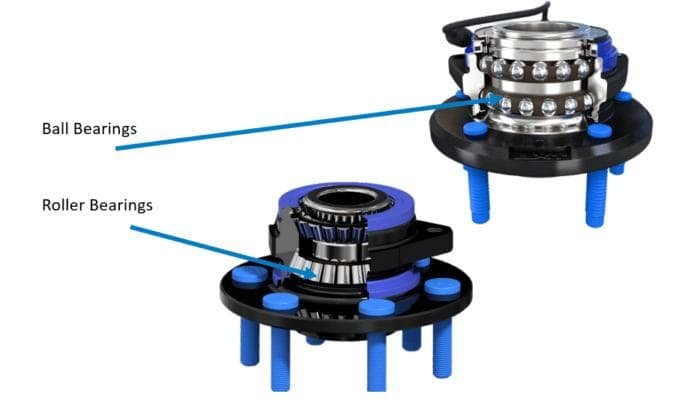
Wheel bearings make sure your vehicle stays steady and stable during the drive and its weight is perfectly balanced. The automotive industry relies on the wheel bearings more than you imagine. The types of wheel bearings are:
1. Ball Bearings
It is the most common type of wheel bearing and is very versatile. Their design allows both radial (side) and thrust (axial) loads. These bearings are very useful in smaller vehicles as they are simple and effective in different environments.
Important Characteristics
- They can handle high speeds.
- These can tolerate radial and thrust loads.
- They are used primarily in light motor vehicles.
2. Tapered Roller Bearings
Tapered roller bearings bear heavy radial and axial loads like ball bearings. Their cone-like shape provides an even distribution of weight. They are very suitable for vehicles with high stresses, like trucks, SUVs, performance cars, and others.
Key Features:
- They have the ideal load-handling capability.
- These are primarily found in the front and back wheel hubs.
- It provides durability and strength for heavy use.
3. Hub Bearings
Hub bearings are already sealed units having both the bearing and the hub together in one unit. These are sealed units, and that’s why they are maintenance-free. Also, they’re designed to be hassle-free for a long time. They are present pretty commonly in new vehicles since their installation is simple, besides being very effective at their application.
Important Characteristics:
- These bearings have integrated designs for additional durability.
- They are sealed to minimize contamination.
- Reduces the requirement of regular upkeep.
4. Roller Bearings (Cylindrical)
Cylindrical ones are less frequent than ball or tapered roller bearings. However, some wheel assemblies use cylindrical roller bearings for heavy-duty uses. These handle radial loads but not very good with axial loads.
Key Features:
- They have strong radial load capacity.
- These have limited application in automotive wheel hubs.
5. Double Row Bearings
They have two rows of rolling elements:
- balls
- or tapered rollers
They give more stability and load-carrying capability. You can use them in higher-performance and reliability vehicles.
Key Features:
- They have increased load support and stability.
- Typical for high-performance or heavy-duty vehicles.
How Does a Wheel Bearing Work?
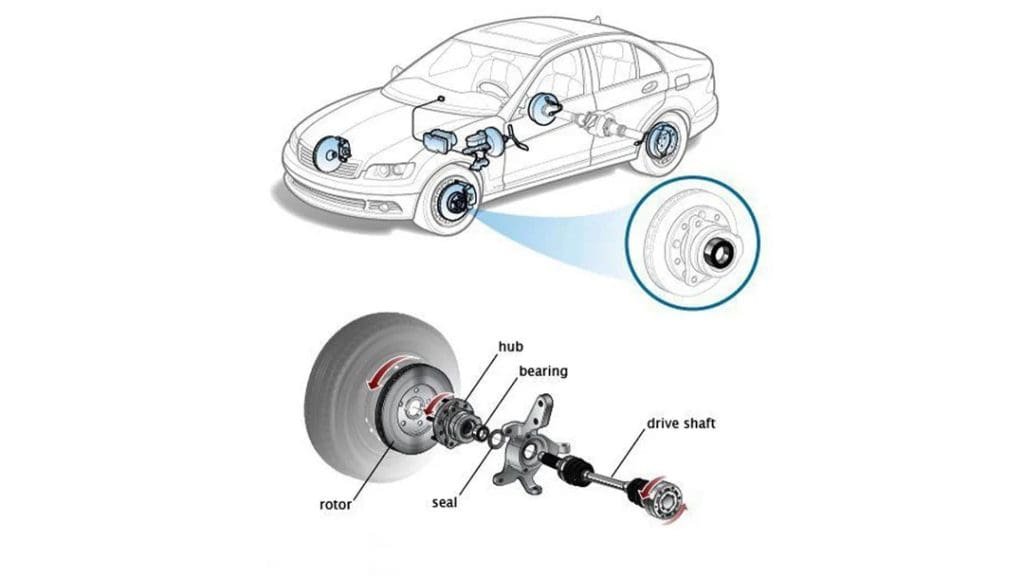
Wheel bearings facilitate smooth wheel rotation and support the vehicle’s weight. It works on the basis of lessening friction between the wheel and the axle to allow the wheels to spin freely with stability.
Some of the important wheel bearing function components are:
Rolling Elements
Balls or rollers are inside an inner and an outer race and provide less friction interface to the mobile and stationary parts.
Inner Race
The inner race is attached to either the axle or the wheel shaft and subsequently turns with the wheel action.
Outer Race
It is fixed with the wheel hub but doesn’t move itself.
Seals/Shields
This part basically avoids dirt, debris, and moisture in a bearing and wheel assembly.
Lubricant
A film of grease or oil decreases wear and tear via reducing friction between the rolling elements and the races.
Working Mechanism
Wheel bearing allows a low-friction interface between the wheel and the axle, thereby carrying the weight of the vehicle. This is obtained from precision-engineered rolling elements and races, enabling effective rotation and stability of operation.
This bearing improves the performance and service life of bearings via improved sealing systems and excellent quality lubrication. Consequently, secure driving is maintained smoothly.
So, it is important to replace a faulty wheel bearing early to make sure there are no future issues that could cost you so much money to get corrected.
Signs of Bad Wheel Bearings
Your vehicle’s performance and safety do depend on wheel bearings. So, it’s important to identify damage signs early, such as:
1. Unusual Noises
A failing wheel bearing often makes unusual noises that can warn of impending problems. You will probably notice a grinding or growling noise. It happens from metal-on-metal contact due to a lack of lubrication. This noise usually will get louder with speed.
Another familiar symptom of faulty bearings is the humming or whining sound which is more easily noticed in straight driving conditions. This sound means general wear of the bearings.
Also, clicking or rumbling noises during turns may indicate a damaged or worn-out bearing that needs to be addressed immediately. These specific sounds are very important indications that the wheel bearing is failing and should be replaced.
2. Wheel Wobble or Vibration
If the wheel bearings are loose, they may cause wobbling and vibrations in the wheel assembly. You’ll notice this vibration coming from the steering wheel that gets intense with higher speed.
You may also notice it if you raise the vehicle and manually shake the wheel. if there is excessive side-to-side movement or play, a bearing could be faulty. These are indications of wheel instability, something you should attend to as soon as possible to avoid further deterioration or safety issues.
3. Uneven or Excessive Tire Wear
Damaged wheel bearings can cause uneven pressure on the tires leading to irregular or rapid wear. This is because the wheel will not rotate as smoothly or evenly as it should.
4. ABS Malfunction Indicator
ABS is available in most modern cars. There are sensors near the wheel bearings. A failing bearing can interrupt these sensors and can turn on the ABS warning light on your dashboard.
5. Pulling to One Side
It is also a sign of bad bearing if during cornering or applying brake your vehicle starts pulling to one side. This is because the affected wheel would have uneven friction or resistance.
6. Increased Rolling Resistance
A faulty wheel bearing increases rolling resistance within the wheel assembly and creates friction that can affect the vehicle’s general performance. This forces the engine to work harder, as it has to use more energy to move. Therefore, it reduces fuel efficiency. Besides, you may feel your car slow or less responsive. It makes it difficult for any driver to regulate speed effortlessly.
7. Overheating Near the Wheel
If the bearing is bad, it generates too much heat. You can even feel this heat around the wheel area. In extreme cases, you might see smoke coming from the wheel area.
Can I Drive with a Bad Wheel Bearing?
No, you cannot drive if your wheel bearing is damaged. Why? It compromises the performance of your vehicle and increases the risk of accidents. During driving, if the bearing continues to deteriorate, then there is a likelihood of more serious problems.
For example, it will increase the risk of wheel locking and detachment from the vehicle. Additionally, excessive wear on other components results in damage to the hub, axle, and suspension, which might prove very costly to repair.
Conclusion
Wheel bearings are important components that allow smooth wheel rotation and support the load of your vehicle. There are multiple types of wheel bearings with different characteristics and applications.
If you want more information regarding bearings, visit BYWB Bearings. We are leading bearing manufacturers and suppliers in China. Our R&D team and staff are professional and available 24/7. So, contact us for your next bearing order!
