
Introduction
Hybrid ceramic bearings have become a go-to choice where performance, longevity, and reliability matter. By combining ceramic rolling elements with steel races, these bearings deliver many of the benefits of ceramics while avoiding some of the limitations of all-ceramic designs. In this guide from BYWB Bearing we’ll explain what hybrid ceramic bearings are, list their advantages, compare them with full ceramic bearings, and give guidance on where to use each type.
What is a hybrid ceramic bearing?
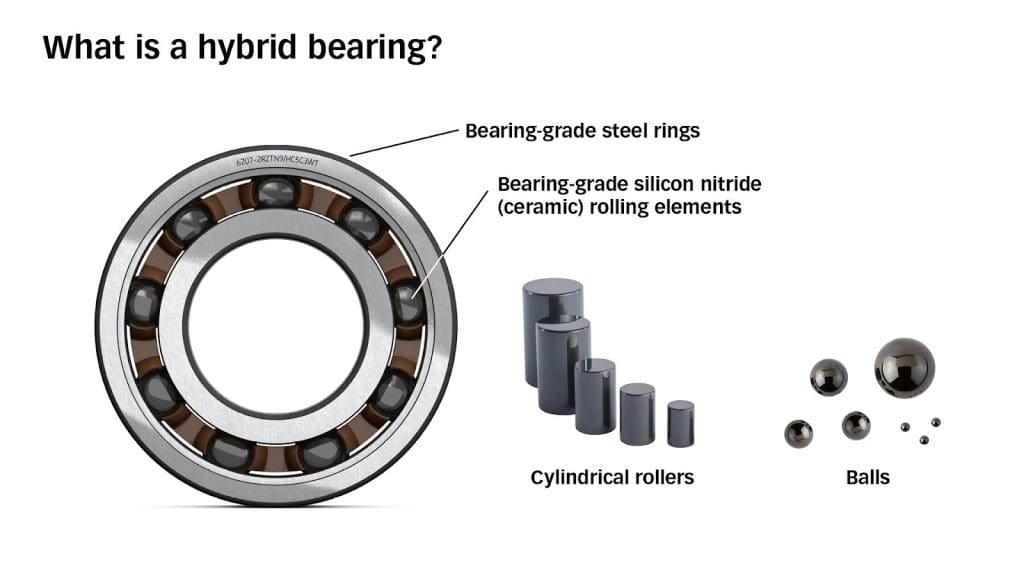
A hybrid ceramic bearing pairs ceramic rolling elements (usually silicon nitride, Si₃N₄) with metal inner and outer rings (commonly chrome steel or stainless steel). The cage (separator) can be steel, brass, or high-performance polymers depending on the application. This hybrid design leverages the low mass, hardness, and smoothness of ceramic balls together with the toughness and impact resistance of metal raceways.
Key components:
Ceramic balls (Si₃N₄ or ZrO₂): Lower density and higher hardness than steel, with excellent thermal stability and electrical insulation.
Steel races (AISI steel or stainless): Provide ductility, shock resistance and cost-efficiency.
Cage: Material chosen based on speed, lubrication, and contamination factors.
This combination is why hybrid bearings are often described as an ideal compromise — taking the best mechanical and tribological properties from both materials.
How hybrid ceramic bearings work — the science in short
Ceramic balls are harder and smoother than steel balls. A smoother rolling surface reduces micro-asperity contact, which lowers friction and heat generation during rotation. The lower density of ceramics also reduces centrifugal forces at high RPM, enabling higher safe rotational speeds. Meanwhile, the steel rings maintain structural resilience under shock and misalignment, and they’re easier/cheaper to manufacture to common bearing standards. Together, these properties yield bearings that run cooler, last longer, and perform better under many demanding conditions.
Advantages of hybrid ceramic bearings
Below are the major benefits that make hybrid ceramic bearings attractive across industries like electric vehicles, aerospace, machine tools, and robotics.
1. Lower friction and higher speeds
Ceramic balls have superior surface finish and lower rolling resistance compared with steel balls. That means hybrid bearings generate less heat and can safely run at higher speeds — a major benefit for spindles, EV motors, and high-RPM machinery.
2. Longer service life
Because ceramic materials wear far less than steel under similar conditions, hybrid bearings typically deliver multi-times longer life than all-steel bearings in identical operating envelopes — especially where boundary lubrication and contamination are issues.
3. Better temperature stability and lower thermal growth
Ceramics have lower thermal expansion and better high-temperature properties than steel. Hybrid bearings therefore exhibit reduced dimensional change with temperature, improving running accuracy in applications with thermal cycling.
4. Electrical insulation / immunity to stray currents
Ceramic balls are electrically insulating — hybrid bearings help prevent bearing current damage (electrical erosion) which can be a serious problem in motors driven by variable-frequency drives (VFDs) or in e-machines. This can significantly reduce pitting and fluting on raceways.
5. Corrosion and chemical resistance (partial)
While hybrid bearings still have steel races that can corrode, the ceramic rolling elements are inherently corrosion resistant. In some corrosive environments, hybrid bearings with stainless steel races or protective coatings can outperform all-steel bearings. That said, full ceramic bearings remain superior if absolute corrosion resistance is the priority.
6. Weight savings
Ceramic balls weigh less than steel balls, reducing centrifugal loads and, in rotating assemblies, contributing modestly to overall weight savings. This is particularly attractive in aerospace and competitive cycling applications.
Limitations & trade-offs of hybrid ceramic bearings
No technology is perfect — here are common considerations when choosing hybrids.
Cost: Hybrid bearings cost more than comparable all-steel bearings because ceramic materials and the specialized manufacturing steps are more expensive.
Corrosion risk (steel races): Hybrid bearings are not as corrosion-resistant as full-ceramic bearings unless you use stainless steel or coatings for races.
Impact load sensitivity: Ceramic balls are hard but more brittle than steel. Under severe shock or repeated heavy impacts, the ceramic elements can crack. However, because the races are steel, hybrid bearings typically tolerate shock better than full-ceramic designs.
Lubrication: Hybrids usually still need lubrication; full-ceramic bearings can sometimes operate in dry or vacuum environments where lubricants are not viable.
Hybrid vs Full Ceramic Bearings — a direct comparison
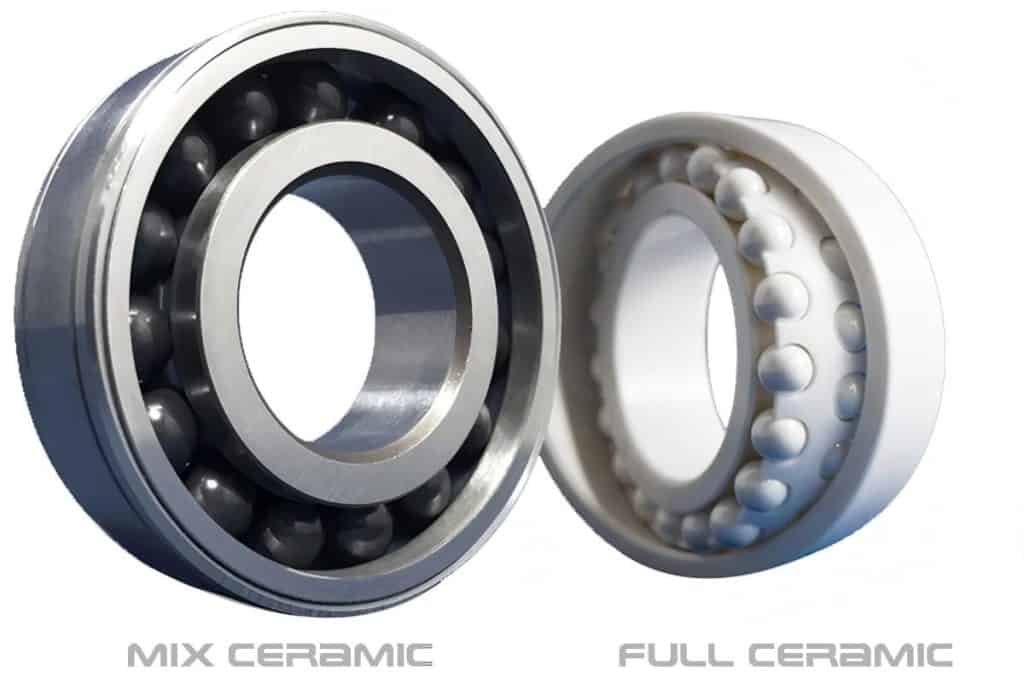
Below is a practical head-to-head summary to help choose the right solution.
Construction
Hybrid: Ceramic balls + steel inner/outer rings (plus cage).
Full ceramic: Ceramic balls + ceramic rings and sometimes ceramic cages.
Strengths of hybrid bearings
Better shock resistance (thanks to steel races).
Typically able to handle higher radial/axial loads than full ceramic in impact situations.
Better suited for high-speed rotating machinery where toughness and speed are both required.
Strengths of full ceramic bearings
Superior corrosion resistance and chemical inertness.
Can run with minimal or no lubrication in vacuum or aggressive chemical environments.
Lighter overall (when whole bearing is ceramic) and electrically insulating throughout.
Typical application guidance
Choose hybrid when you need high speed, lower friction, and better shock tolerance than full ceramic, but still want improved lifetime vs. steel. Common uses: EV motors, high-speed spindles, robotics, and electrified drivetrain components.
Choose full ceramic when corrosion, chemical exposure, or operation without lubrication (e.g., vacuum) is the dominating factor — for instance specialized lab equipment, some aerospace or chemical processing uses.
Real-world performance: what tests show
Independent studies and vendor case studies point to consistent performance improvements with hybrid bearings:
Lower rolling resistance and reduced heat generation, which improves efficiency and lifetime.
Reduced electrical erosion in electrically active environments, leading to fewer bearing failures in electric motors.
Extended service life — many manufacturers and users report multi-fold life increases compared to all-steel bearings in similar operating conditions.
(When comparing specific products, examine vendor test data for speed, load, lubrication, and contamination conditions — results vary with operating scenario.)
Selection tips — how to pick the right hybrid bearing
- Specify the ball material: Silicon nitride (Si₃N₄) is most common for high-speed/industrial applications; zirconia (ZrO₂) is used when corrosion resistance and toughness at certain temperatures are needed.
- Choose the race material: Chrome steel for general use; stainless steel (AISI 440C / 316) for corrosive environments.
- Cage choice matters: For ultra-high-speed use choose light polymer or PEEK cages; use brass/steel cages for heavy-duty or high-temperature situations.
- Consider coatings: For added corrosion resistance, look for bearings with protective coatings on the steel races or opt for stainless races.
- Match lubrication & clearance: Hybrid bearings still need appropriate lubrication and correct internal clearance; consult bearing manufacturer data for grease/oil recommendations.
Applications where hybrids shine
Electric vehicle motors and wheel bearings: reduced losses, electrical insulation, longer life.
High-speed spindles and machine tools: lower friction and thermal stability.
Aerospace & drones: weight savings and durability under varied thermal conditions.
Robotics and precision instruments: smoother rotation and improved positional accuracy.
BYWB Bearing’s recommendation (short)
If your application demands a balance of high speed, low friction, longer service life, and improved electrical isolation, hybrid ceramic bearings are often the best compromise between performance and cost. If absolute corrosion resistance, chemical inertness, or operation in vacuum/no-lube environments are required, full ceramic bearings may be the better—but more specialized—choice. For most industrial and automotive use-cases BYWB Bearing recommends hybrid designs tailored to the operating temperature, contamination level, and expected shock loads.
How to clean hybrid ceramic bearings
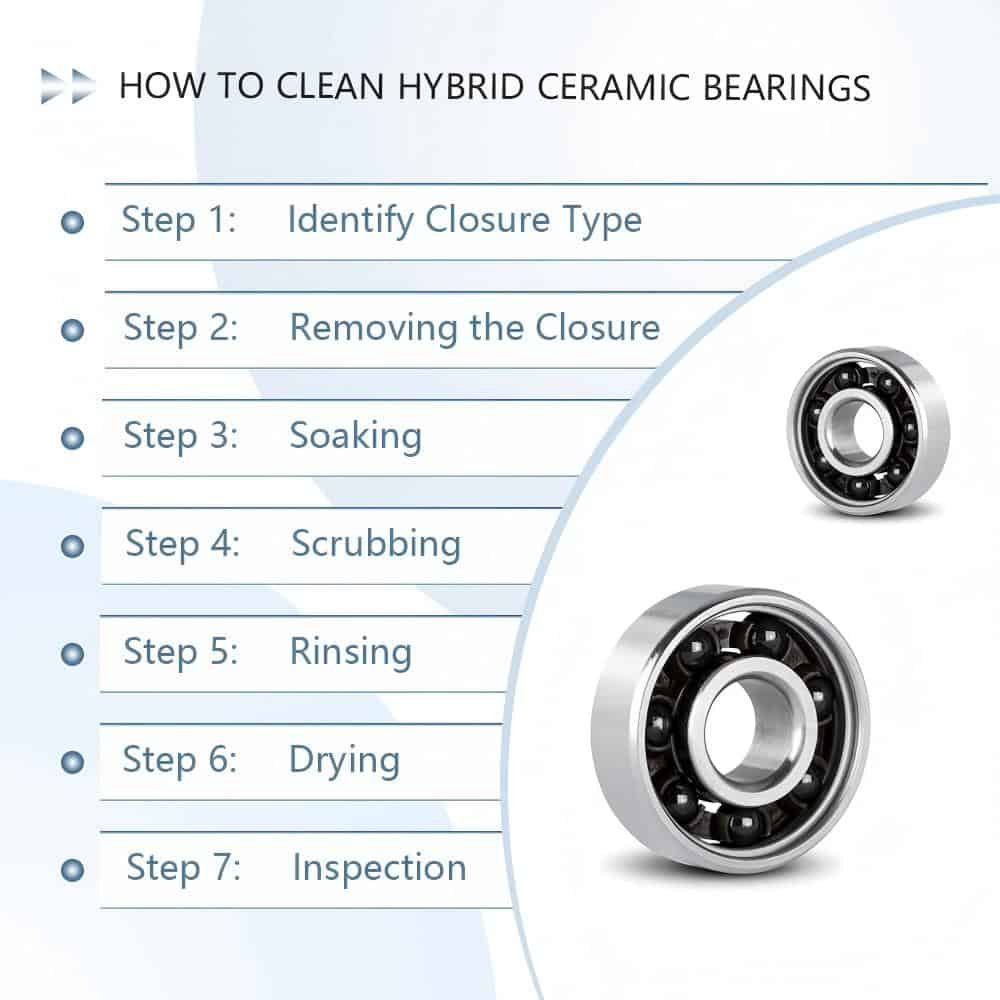
Proper cleaning is essential to maintain performance and extend bearing life.
- Remove the bearing carefully from its housing or wheel hub.
- Use a mild solvent or bearing cleaner such as isopropyl alcohol or specialized bearing cleaning fluid. Avoid harsh acids or chlorinated solvents that could damage the steel races.
- Soak and agitate the bearing in the cleaning solution for several minutes to dissolve grease and contaminants.
- Use compressed air or a lint-free cloth to dry completely — do not spin the bearing with high air pressure, as it may damage the races.
- Re-lubricate with appropriate bearing grease or oil before reassembly. For high-speed hybrid bearings, use low-viscosity synthetic grease recommended by the manufacturer.
- Inspect the bearing for wear, cracks, or discoloration before reinstalling.
Regular cleaning and proper lubrication help hybrid ceramic bearings maintain low friction, avoid premature wear, and ensure reliable high-speed operation.
Conclusion
Hybrid ceramic bearings combine the advantages of advanced ceramics with the toughness of steel raceways, delivering lower friction, higher speed capability, electrical insulation, and extended life compared to traditional steel bearings. They are not a universal replacement for full ceramic or steel bearings — the right choice depends on the application’s priorities: corrosion resistance and extreme environments favor full ceramic; speed, durability, and impact tolerance often favor hybrids. BYWB Bearing can help you select the precise bearing materials, clearances, and lubrication strategy to maximize performance and ROI for your application.
