
Introduction
Roller bearings are key components in countless industrial machines, enabling shafts and other rotating parts to carry heavy loads while minimizing friction. Their cylindrical rolling elements provide much greater contact area than balls, so roller bearings can support very high radial loads and often handle moderate axial loads as well. These qualities make roller bearings indispensable in heavy equipment, aerospace, power generation, automotive drives, and more.
In practice, engineers and procurement teams trust suppliers like BYWB Bearing to deliver precision-engineered roller bearings that sustain efficiency and extend machine life. BYWB Bearing is known for reliable, high-quality bearings that reduce friction and prolong service intervals, helping companies keep critical machinery running smoothly.
What Is a Roller Bearing?
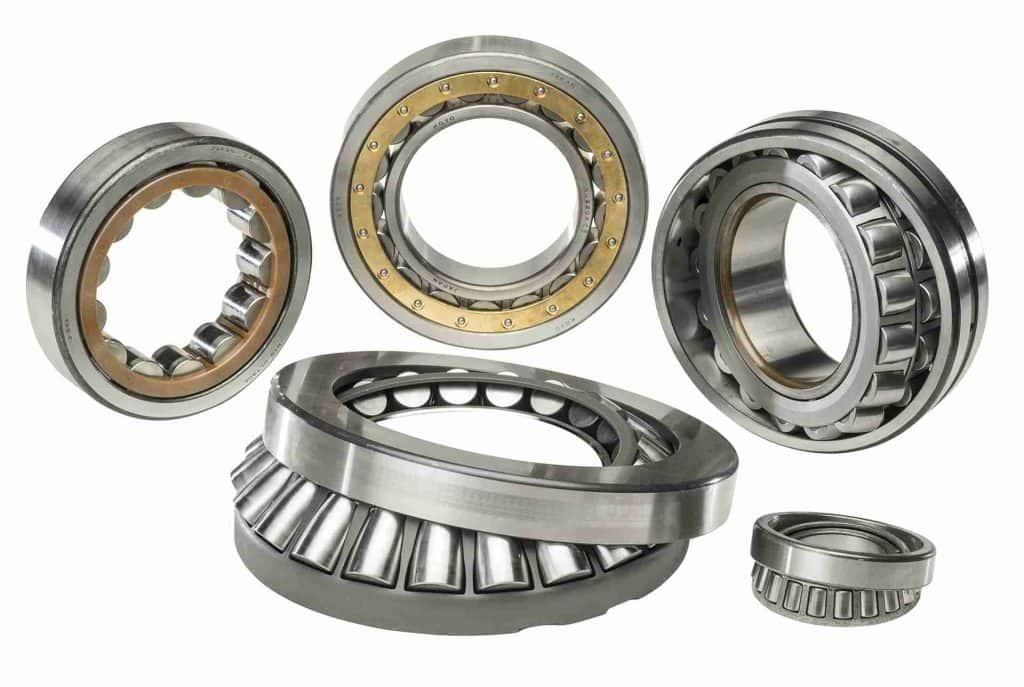
A roller bearing is a type of rolling-element bearing that uses a cylinder (roller) instead of a ball to maintain separation between the bearing races. The fundamental function of a roller bearing is to support a rotating shaft while allowing smooth motion under load. Roller bearings typically consist of two concentric rings (inner and outer raceways) with a set of rollers between them. The rollers are guided by a cage or separator that keeps them evenly spaced and prevents roller-to-roller contact.
This construction results in greater contact area compared to ball bearings. The cylindrical rollers distribute the load along a line contact, allowing roller bearings to support heavier loads. The cage ensures uniform roller alignment, maintaining smooth motion with minimal friction and heat generation. This design also reduces the need for frequent lubrication and increases bearing life, especially under high-load conditions.
Types of Roller Bearings and Their Applications

Roller bearings are manufactured in various configurations to handle different load types and alignment requirements. The most common types include:
1. Cylindrical Roller Bearings
These bearings use rollers that are longer than their diameter and offer exceptional radial load capacity. They are commonly used in high-speed applications like electric motors, gearboxes, pumps, and machine tool spindles. Cylindrical roller bearings can support heavy radial loads but typically offer limited axial load capacity unless modified.
2. Spherical Roller Bearings
Spherical roller bearings have two rows of barrel-shaped rollers and are self-aligning. This allows them to accommodate misalignment or shaft deflection while still handling heavy radial and moderate axial loads. They are widely used in industries like mining, material handling, wind turbines, and heavy-duty conveyors.
3. Needle Roller Bearings
Needle roller bearings use long, thin cylindrical rollers that allow high radial load capacity in compact designs. Due to their small cross-section, they are ideal for applications with radial space limitations, such as automotive transmissions, power tools, and gear pumps.
4. Tapered Roller Bearings
These bearings feature conical rollers and can support both radial and axial loads. The rollers are angled so that the load is transmitted both radially and axially. Tapered roller bearings are commonly used in wheel hubs, axles, and gearboxes. Each bearing handles axial load in one direction; paired bearings handle bidirectional thrust.
Table: Comparison of Roller Bearing Types
| Bearing Type | Load Capacity | Typical Applications |
| Cylindrical Roller | Very high radial; limited axial | Motors, gearboxes, pumps, machine tools |
| Spherical Roller | Very high radial and moderate axial | Mining, conveyors, wind turbines, crushers |
| Needle Roller | High radial; compact design | Automotive, transmissions, compact machinery |
| Tapered Roller | Combined radial and axial (one direction) | Wheel hubs, heavy equipment, industrial gearboxes |
Roller Bearings vs. Ball Bearings
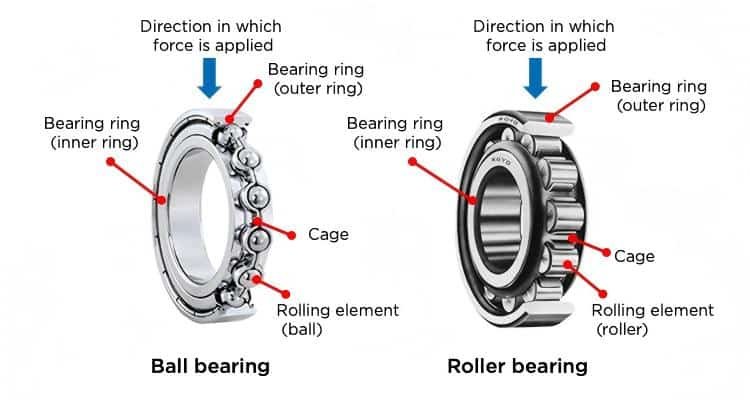
Although both roller and ball bearings reduce friction in rotating parts, their geometry and performance characteristics differ:
Rolling Element Shape:
Ball bearings use spherical balls; roller bearings use cylindrical rollers. Balls create point contact, rollers create line contact.
- Load Capacity:
- Line contact in roller bearings enables them to handle significantly higher radial loads. Ball bearings are better suited to lighter loads.
Speed Capability:
Ball bearings offer lower friction and are preferred for high-speed applications. Roller bearings, while robust, generally operate at lower maximum speeds.
Shock Resistance and Durability:
Roller bearings are superior in resisting impact and shock loads due to the larger contact surface. They have a longer service life under heavy loads.
Misalignment Tolerance:
Some roller bearings (especially spherical types) can handle misalignment, but generally ball bearings are more forgiving in this area.
Applications:
Ball Bearings: Electric motors, fans, bicycles, medical instruments
Roller Bearings: Gearboxes, construction equipment, turbines, crushers, axles
Advantages of Roller Bearings
Roller bearings offer multiple advantages in industrial and heavy-duty applications:
Higher Load Capacity
The increased surface contact allows roller bearings to support greater radial and axial loads.
Reduced Friction
The rolling mechanism minimizes friction compared to sliding contact in plain bearings, improving efficiency.
Longer Service Life
With proper lubrication and alignment, roller bearings typically last longer under high-stress conditions.
Heat Resistance
Due to lower friction, less heat is generated during operation, helping maintain grease life and prevent overheating.
Durability in Harsh Environments
Roller bearings are built for rugged applications where dust, impact, and vibration are common.
Lower Maintenance
Many roller bearings require minimal maintenance over their operational lifetime, reducing downtime and cost.
Compact Design (Needle Type)
Where space is tight, needle roller bearings provide a high-load solution in a small footprint.
These benefits make roller bearings a reliable choice for demanding industries where consistent performance is critical.
Why Choose BYWB Bearing
At BYWB Bearing, we specialize in manufacturing and supplying premium roller bearings for global industrial clients. Here’s why engineers and procurement managers choose us:
1. Precision Engineering
Our roller bearings are produced using high-grade steel and advanced manufacturing techniques. Each unit meets strict tolerance and performance standards.
2. Wide Product Range
BYWB Bearing offers:
Cylindrical roller bearings
Spherical roller bearings
Tapered roller bearings
Needle roller bearings
We support both standard and custom specifications.
3. Custom Solutions
We understand that every application is unique. Our engineering team can customize bearing size, cage design, sealing, and lubrication to meet your exact needs.
4. Reliable Quality Control
Our rigorous testing procedures include dimensional inspection, noise and vibration analysis, and material hardness checks to ensure reliability.
5. Global Logistics and Support
With an efficient supply chain and responsive sales team, we deliver timely support for both small-volume and bulk orders.
6. Application Expertise
From agriculture to construction equipment, automotive to wind energy, we help clients select the best-fit bearing for their application.
Conclusion
Roller bearings are essential to modern industry, offering high load capacity, reduced friction, and long-term reliability in demanding environments. By choosing the right bearing type—cylindrical, tapered, spherical, or needle—engineers can improve equipment performance and minimize maintenance.
When you need dependable, high-performance roller bearings, BYWB Bearing is your trusted partner. With quality manufacturing, tailored solutions, and expert support, we’re committed to keeping your machinery running smoothly.
