
Plastic bearings — sometimes called polymer bearings or engineered-plastic bearings — have grown from a niche component into a mainstream solution for many industries. Advances in polymer chemistry, reinforced composites, and molding technology now allow plastic bearings to replace metal bearings in many low- to medium-load, low- to moderate-speed applications. Their main appeals are corrosion resistance, low maintenance (often self-lubricating), low noise, and the ability to be molded into complex shapes such as ready-to-install bearing units.
This comprehensive guide explains what plastic bearings are, the most common types (with special focus on plastic bearing units), where they perform best, the key advantages and limitations, selection and design tips, installation and maintenance practices, and a short FAQ to help engineers, purchasers, and design teams make confident choices.
What is a plastic bearing?

A plastic bearing is any bearing in which the primary load-bearing surfaces are made from engineered polymers or polymer composites rather than traditional metals like steel or bronze. Plastic bearings include plain sleeve bushings, flanged bushings, molded bearing inserts, plastic caged ball bearings, composite bearings (polymer bonded to metal backing), and fully molded bearing units that include housing and mounting features.
Plastic bearing materials range from simple nylons and acetals to high-performance polymers filled with glass, carbon, or solid lubricants (such as PTFE). Many engineered plastics are formulated to be self-lubricating, chemically resistant, and dimensionally stable, making them attractive for certain environmental or maintenance-sensitive applications.
Common materials used in plastic bearings
Understanding material properties is essential when selecting a plastic bearing. Typical material families and their attributes include:
- PTFE (Polytetrafluoroethylene): Extremely low friction and excellent chemical resistance. Often used in composite formulations or as a solid-lubricant phase in a polymer matrix. Best for low-friction sliding under moderate loads; not typically used alone where structural stiffness is required.
POM / Acetal (Polyoxymethylene): Good stiffness, strength, dimensional stability, and machinability. Widely used for cages, rings, and medium-duty bearing components.
Nylon (Polyamide): Tough, impact-resistant, and low-cost; used in cages, housings, and some wear components. Absorbs moisture which may affect dimensions.
UHMW (Ultra-High-Molecular-Weight Polyethylene): Very tough, abrasion-resistant, and low-friction; performs well in impact and abrasive environments.
- PEEK (Polyether Ether Ketone): High-performance thermoplastic with excellent mechanical strength, temperature resistance, and chemical resistance. Used in demanding applications where temperatures or loads are higher.
Filled/Composite Polymers: Thermoplastics or thermosets reinforced with glass fiber, carbon fiber, or solid lubricants (graphite, PTFE). These blends are tailored to improve load capacity, wear resistance, and thermal behavior.
Metal-backed plastics: Thin polymer layers molded or bonded onto a metal backing combine the dimensional stability and load distribution of metal with the sliding properties and corrosion resistance of polymer.
Selecting the right material requires considering load, speed, temperature, environment (chemicals, water, salt), electrical insulation needs, and whether the application allows dry operation or requires lubrication.
How plastic bearings are manufactured
Plastic bearings are manufactured by several processes, chosen based on part geometry, tolerances, volume, and cost:
Injection molding: The most common process for high-volume plain bushings, flanged bushings, and bearing housings. Enables complex shapes and integrated mounting features.
Machining: Used for prototypes, low-volume runs, or when tight tolerances or specific finishes are required. Machined polymer bushings are common for custom parts.
Overmolding / Bonding: Polymer layers are molded onto metal backings to produce metal-backed bearings that combine strength with a polymer sliding surface.
Sintering / Compression molding: Used for certain composite materials or specialty polymer blends.
Assembly: For plastic ball bearings, cages or rings are molded then assembled with metal or ceramic balls where needed.
Manufacturing choice affects part cost, tolerances, thermal behavior, and achievable geometries (e.g., complex mounting bosses, integral flanges, or snap-in features).
Types of plastic bearings (detailed)

Plastic bearings come in many forms. Below is a practical classification with common uses.
1. Plain (sleeve) plastic bearings / bushings
Sleeve bearings are cylindrical sleeves that provide sliding support for a shaft. Variants include:
Standard sleeve bushings — provide radial support.
Flanged bushings — include a flange to locate the bearing axially, simplifying assembly.
Split bushings — two-piece designs for retrofit or easy shaft removal without disassembling surrounding structures.
Thrust washers — flat polymer discs for axial load support.
Sleeve bushings are widely used in appliances, conveyors, pumps, electric actuators, and any application where moderate radial loads and low- to moderate speeds are present.
2. Plastic ball bearings
Plastic ball bearings use polymer rings or cages with balls that can be plastic, ceramic, or stainless steel. They suit applications that need corrosion resistance or electrical insulation, such as marine equipment, chemical pumps, and certain medical devices. For higher precision and speeds, hybrid designs use steel or ceramic balls with polymer cages/rings.
3. Flanged plastic bearings and mounted units
Flanged bearings have an integral flange for axial location. When combined with molded housings or mounting plates, they become plastic bearing units — ready-to-install components. Common unit styles:
Single-bolt / two-bolt flange units
Pillow block / plummer block housings
Insert bearings for housings (press-fit inserts)
Snap-in clip bearings for thin panels
Mounted units speed up assembly, simplify alignment, and often include dust lips or seals.
4. Self-lubricating engineered-plastic bearings
These are polymers compounded with solid lubricants (e.g., PTFE, graphite) facilitating dry operation. They’re used where relubrication is undesirable or impossible: food processing lines, medical devices, and sealed assemblies.
5. Composite and metal-backed polymer bearings
Metal-backed polymer bearings combine a thin metal backing for strength and heat dissipation with a polymer wear layer. They are suitable when bearing dimensions must be precise and load distribution is important.
6. Specialized shapes: clip bearings, wear rings, and guides
Snap-in clip bearings, wear rings, guide rails, and custom molded components help reduce part count, speed assembly, and integrate functions like seals or mounting bosses.
Special emphasis: Plastic bearing units
Plastic bearing units are a key growth area. These are integrated parts combining a polymer bearing with a housing or mounting flange. Benefits include:
Fast installation: pre-sized units reduce on-site measuring and machining.
Design simplicity: housing and bearing molded as a single assembly reduces part count.
Corrosion resistance: fully polymer units or polymer housings resist rust in washdown or marine environments.
Integrated protection: dust lips or wipers can be molded in to protect the bearing from contamination.
Common unit styles used in manufacturing and material handling include two-bolt flange units for conveyor and guide systems, pressed-in insert bearings for pillow blocks, and clip-in bearings for sheet metal panels. These units make maintenance predictable and spare-part management easier for production lines.
Applications — where plastic bearings excel
Plastic bearings are widely used where their specific advantages (corrosion resistance, self-lubrication, noise reduction, electrical insulation, ease of integration) are important. Typical sectors and examples:
Food & beverage processing: washdown and chemical-resistant grades avoid rust and contamination risk.
Medical & laboratory equipment: low noise, clean operation, and chemical compatibility.
Packaging and material handling: mounted plastic units and flanged bushings cut maintenance on conveyors and robot end-of-arm tooling.
Consumer appliances & office equipment: quiet operation and self-lubrication make plastics suitable for printers, scanners, washing machines, and fans.
Marine / outdoor equipment: saltwater resistance and non-corrosive housings extend service life.
Electronics & telecommunications: electrical insulation and non-magnetic properties suit sensitive equipment.
Automotive (non-critical systems): interior actuators, HVAC components, and light-duty guides.
Industrial OEM machinery: guide bushings, wear rings, and custom molded bearing features.
Agricultural machinery: polymer bearings resist corrosion and stand up to moderate dirt and impact.
Plastic bearings are particularly valuable where maintenance is difficult or contamination control is critical.
Advantages of plastic bearings
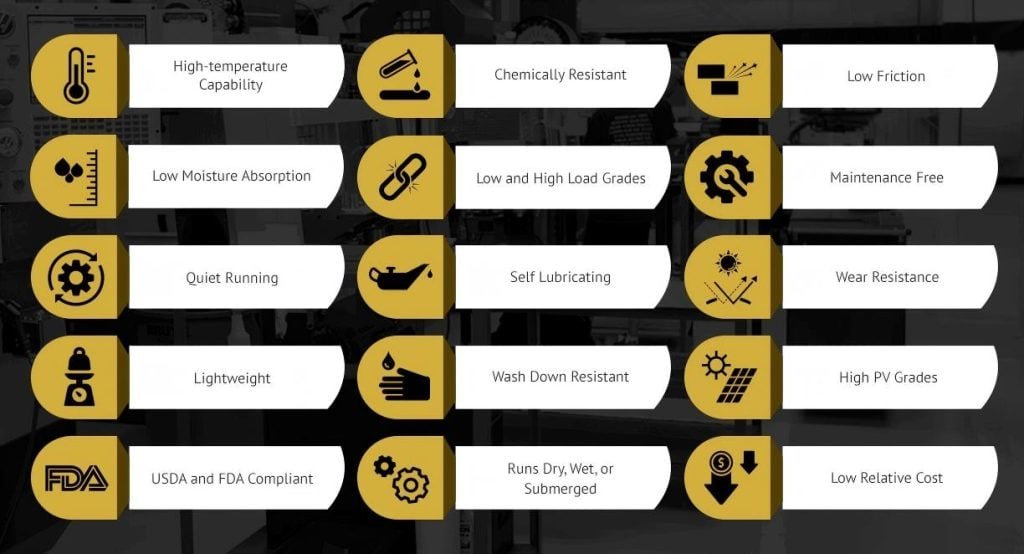
Plastic bearings offer several clear advantages over metal bearings in appropriate applications:
1. Corrosion resistance & chemical tolerance
Polymers resist water, salts, acids, and many alkalis, making plastic bearings ideal in wet or chemical-exposed environments.
2. Self-lubrication and low maintenance
Engineered plastics with solid lubricants enable dry operation and reduce or eliminate relubrication, lowering maintenance frequency and contamination risk.
3. Low noise and vibration damping
Plastic bearings reduce operational noise and damp vibration — a major benefit in appliances, medical devices, and consumer equipment.
4. Electrical insulation and non-magnetic behavior
Plastic bearings provide dielectric isolation and are non-magnetic, useful in electrical and sensitive measurement applications.
5. Lightweight and flexible design
Polymers are lighter than metals. Injection molding enables complex shapes and integrated features (flanges, snaps, seals), simplifying assemblies and lowering production cost.
6. Good performance in dirty environments
Because many plastic bearings perform well without external lubrication and tolerate contamination better than lubricated metal bearings in some dirty environments, they can be preferable in dust-prone machinery.
7. Economical in high volumes
For high-volume OEM production, injection-molded polymer bearings and units reduce part cost and assembly labor compared with machined metal components.
Limitations and design considerations
Plastic bearings are not a drop-in replacement for metal bearings in every case. Key limitations:
Load capacity & temperature: Plastics generally have lower maximum load capacities and lower continuous operating temperatures compared to hardened steel bearings. High-load, high-temperature, or high-speed applications usually still require metal or hybrid solutions.
Thermal expansion: Polymers expand more with temperature than metals; clearances and fits must be designed accordingly.
Creep and long-term deformation: Under sustained high loads, some plastics may creep. Reinforced polymers and metal-backed designs mitigate creep.
Abrasive wear: Very abrasive environments can accelerate polymer wear; material selection and sealing are essential.
Precision and high-speed limitations: For very high precision and high RPM applications, metal rolling bearings are often preferable.
Designers must balance these trade-offs and choose the right grade and geometry to match the application.
How to choose the right plastic bearing — step-by-step
- Define operating conditions: shaft diameter and tolerance, radial and axial loads, speeds (surface velocity), temperature range, environment (chemicals, water, dust), and required regulatory compliance (food-grade, medical).
- Select bearing form: sleeve bushing, flanged bushing, plastic ball bearing, or mounted unit. Sleeve bushings are common for low- to moderate-load shafts; ball bearings suit higher speeds and precision.
- Choose material: PTFE composites for low friction and chemical resistance; POM for structural stiffness; PEEK or reinforced polymers for higher temperatures and higher loads. Consider FDA or food-grade options where required.
- Check PV and load ratings: consult manufacturer PV (pressure × velocity) charts and allowable load data to ensure material suitability.
- Define shaft finish & material: polymer bearings often prefer smooth shaft finishes and certain surface hardness; follow supplier recommendations.
- Consider housing & mounting: pick flanged units or press-fit inserts based on assembly process; allow clearance for thermal expansion.
- Prototype & test: field testing helps validate life predictions and uncovers real-world contamination, misalignment, or loading issues.
Installation and maintenance best practices
Shaft finish: aim for recommended surface roughness (often Ra values in the 0.2–0.8 µm range, but check material datasheet).
Press-fit tolerances: follow supplier guidelines to avoid excessive distortion of the polymer part.
Allow thermal clearance: design clearance for polymer thermal growth to prevent binding.
Seals and wipers: integrate seals where contamination or washdown is expected.
Avoid incompatible chemicals: verify chemical compatibility, especially with specialty polymers.
Routine inspection: even self-lubricating bearings benefit from periodic inspection to check for excessive wear or misalignment.
Spare parts planning: bearing units simplify replacements — keep common unit sizes as spare stock for quick change-outs.
FAQs
Can plastic bearings operate without lubrication?
Yes. Many engineered plastics are self-lubricating and are designed for dry operation. However, some applications benefit from external lubrication to extend life.
Are plastic bearings food-grade?
Food-grade polymer bearings exist. Confirm certifications (FDA, EU food contact) with the supplier for direct food-contact applications.
Can plastic bearings be used in motors?
For low-speed, light-duty motors they can. High-speed precision motors generally still require rolling-element metal bearings or specialized hybrid designs.
How long do plastic bearings last?
Service life depends on load, speed, temperature, environment, and material selection. Proper material selection and design validation are vital to achieving expected service life.
BYWB Bearing — helping you choose the right plastic bearing
At BYWB Bearing we help engineers and buyers select the optimal bearing solution for each application. Whether you need a self-lubricating sleeve bushing, a flanged insert, a molded bearing unit, or a plastic ball bearing, we can recommend materials, mounting styles, and tolerances that match your operating conditions. We can also provide sample parts for prototype testing and guidance on shaft finishes and installation tolerances to maximize service life.
If you’d like help selecting a bearing, please share: shaft diameter, expected radial/axial loads, operating speed, temperature range, and the working environment (water, chemicals, dust, washdown). With that information we’ll propose candidate materials and configurations and can supply prototypes for evaluation.
Conclusion
Plastic bearings are a flexible, cost-effective, and maintenance-friendly solution for many modern applications. With corrosion resistance, self-lubrication, low noise, and the ability to be molded into integrated bearing units, they are ideal for food processing, medical equipment, packaging lines, consumer appliances, marine equipment, and many industrial OEM systems. While limitations exist (load, temperature, thermal expansion, and precision), careful selection of bearing form and engineered polymer grade makes plastic bearings a powerful tool in the designer’s toolbox.
For projects where reduced maintenance, quieter operation, corrosion resistance, and design integration are priorities, plastic bearings — especially in ready-to-install bearing units — can significantly reduce total cost of ownership and simplify assembly. BYWB Bearing is ready to assist with material selection, prototyping, and production supply to match your specific needs.
