
Linear bearings are specialized components that support and guide motion along straight paths. They reduce friction and enable smooth, precise linear movement in machines. Unlike ordinary roller bearings (which handle rotary shafts), linear bearings are designed so that the shaft or rail itself slides straight through the bearing. In practice, linear bearings come in two broad categories: slide-type (plain bushings) and rolling-element types (ball- or roller-based). Slide-type bushings are typically made of bronze, PTFE/polymer, or composite sleeves that rely on a lubricating film. Rolling-element linear bearings use recirculating balls or rollers to achieve very low friction. These devices are widely used in applications from sliding doors and 3D printers to industrial automation, wherever precise straight-line motion is needed.
Types of Linear Bearings

Linear bearings take several forms depending on their internal design and application. Common types include:
- Linear Ball Bushings (Linear Ball Bearings): These use rows of hardened steel balls that roll between the bearing body and the shaft. They come in recirculating designs (endless-loop ball cages) for long travel or non-recirculating designs for short, fixed strokes. Recirculating ball bushings offer very smooth, low-friction motion and high accuracy on a hardened round shaft. They can carry substantial loads and achieve micron-level positioning.
Linear Roller Bearings: Instead of balls, these use cylindrical (or needle) rollers to carry the load. Roller bearings can handle higher loads and stiffer support than ball types. Some designs use crossed rollers (orthogonally arranged cylinders) for very high precision and rigidity. Others use long rollers (often with return tracks) on profiled rails.
Sleeve (Plain) Bearings: Also known as linear bushings or slide bearings, these have no moving parts. They consist of a shaped sleeve (often bronze, oil-impregnated metal, or a self-lubricating polymer) that the shaft slides through. Slide bearings are simple, rugged, and tolerant of contamination, but they have higher friction than rolling types.
- Linear Guide Rails (Profiles): These are complete linear guide systems combining a profiled rail and a carriage block. The carriage contains recirculating balls or rollers riding on the rail. Linear guide rails provide extremely smooth motion and high accuracy over long distances.
Each type has typical use cases: ball bushings for medium loads and precision (e.g. 3D printers, small CNC); roller guides for heavy-duty loads (e.g. industrial robots, machine tools); plain sleeves for simple, dirty, or cost-sensitive systems; and full-profile linear guide units for high-speed, high-precision motion systems. BYWB Bearing’s product line includes solutions in all these categories.
What Are the Advantages of Linear Bearings?

Linear bearings offer low friction and high precision compared to sliding guides. By rolling on balls or rollers, they greatly reduce the frictional resistance in a linear motion system. This delivers smoother motion and more accurate positioning.
Other key advantages include:
High Load Capacity and Stability: Despite their low friction, linear bearings can support significant loads. Quality linear guides use hardened steel rails and multiple bearing circuits to carry heavy payloads without bending.
Durability and Longevity: Linear bearings are built from hard steel and robust materials, giving them excellent wear resistance. Linear slides with seals or wipers can keep out dust and contaminants, extending life.
Quiet, Efficient Operation: Because they avoid metal-to-metal sliding, linear bearings run quietly and with low energy loss.
Reduced Maintenance: A well-designed linear bearing requires minimal upkeep. Rolling-element systems usually only need periodic lubrication. Sealed linear bearings need no additional maintenance for extended periods.
Versatility and Customization: Linear bearings come in many sizes, mounting styles, and materials. Engineers can choose sealed or open, single or double rails, and different preload classes.
In summary, the advantages of linear bearings – low friction, high precision, heavy-load capability, quiet efficiency, and long service life – give engineers a competitive edge. BYWB Bearing’s products are engineered around these very attributes.
Where Are Linear Bearings Used?
Linear bearings are found across virtually every industry that needs controlled straight-line movement. Typical applications include:
CNC and Machine Tools: Almost all CNC mills, lathes, and routers use linear bearings on their linear axes.
Factory Automation & Robotics: Automated assembly lines, robotic arms, pick-and-place machines, and conveyors all rely on linear motion components.
3D Printers and Additive Manufacturing: Even hobbyist 3D printers use miniature linear bearings to guide the print head and build platform along the X/Y/Z axes.
Medical and Laboratory Equipment: Linear bearings play a role in medical imaging machines (MRI, CT scanners), surgical robots, lab automation, and diagnostic equipment.
Material Handling, Packaging, and Print Equipment: Packaging machines, labelers, and material conveyors use linear bearings to position products and packages.
Semiconductor and Precision Machinery: The semiconductor industry and inspection/metrology tools require nanometer-level positioning.
In short, linear bearings are ubiquitous wherever smooth, controlled motion is needed – from heavy-duty robots in factories to tiny actuators in medical devices. BYWB Bearing’s product line explicitly targets these sectors.
Linear Bearing Size Chart
Below is a table of typical linear ball bearing (bushing) dimensions for common metric sizes. Each entry is shown as Bore × Outer Diameter × Length in millimeters.
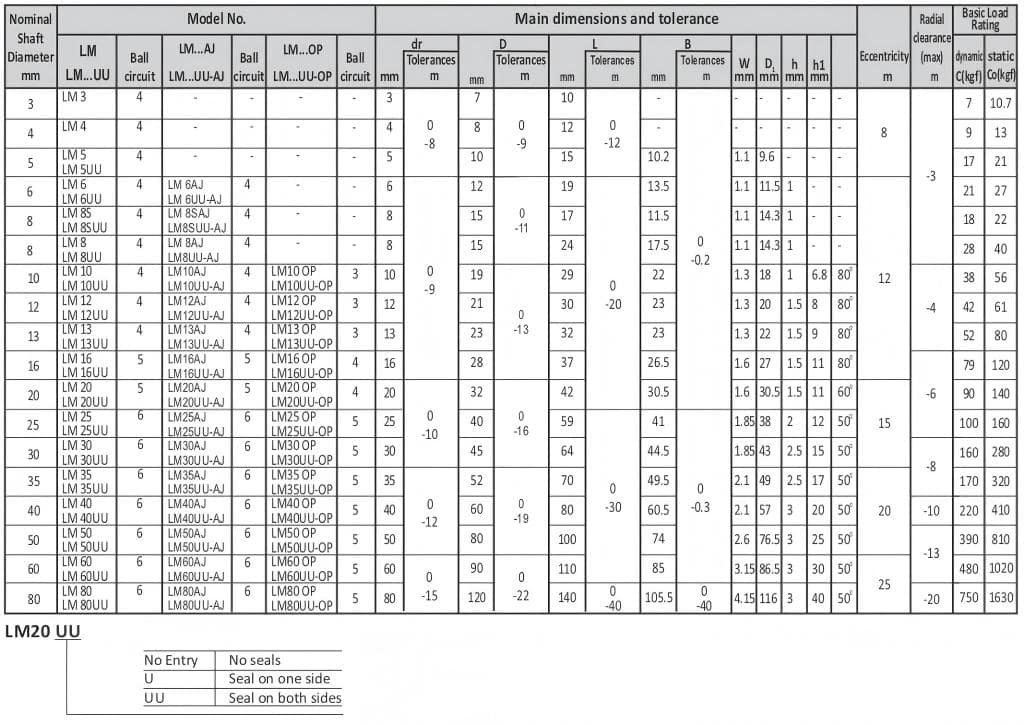
For more sizes and configurations (flanged, extended length, sealed, etc.), engineers can consult BYWB Bearing’s catalogs.
Conclusion
Linear bearings are the backbone of precise straight-line motion in modern machinery. They combine low-friction operation with high load capacity and repeatable accuracy – qualities essential to CNC equipment, automation, robotics, and more.
BYWB Bearing (Boyo Bearing Co., Ltd.) has built its expertise on these principles. That commitment to precision carries over to BYWB’s linear motion products. Their linear ball bearings and guide blocks are manufactured to tight tolerances, using hardened steels and advanced cage designs. In application, this means BYWB’s linear bearings deliver exactly the advantages described above.
For engineers and purchasing managers, the takeaway is clear: when a design calls for smooth, accurate linear motion, BYWB Bearing offers a full range of quality solutions. Whether the requirement is an off-the-shelf linear ball bushing for a small CNC axis, a sealed linear guide for an industrial robot, or a custom-sized slide unit for medical equipment, BYWB’s catalog has options tailored for the job. Consult BYWB Bearing’s product pages and catalogs to find the precise bearing or linear guide for your application.

3人评论了“Linear Bearings: What You Need to Know”
Heya this is somewhat of off topic i want to learn, very good view .
thanks for your comments, we will sharing more tech information
Really solid overview of linear bearings — the distinction between recirculating ball bushings and full-profile linear guide rails finally made it clear which one fits my CNC router’s long-travel axes. The size chart and the LM…UU seal naming (single vs. double-sided) saved me a lot of guesswork when I re-ordered LM10UU bushings for a 3D printer upgrade. Great reference for anyone designing a linear motion system.