
Ball bearings and thrust bearings are well-known types of bearings. Each has advantages of its own kind and provides a lot of value to the mechanical systems. But what if there is a choice between both? Which one do you need to pick? Well, we will tell you which bearing is perfect for you according to your needs. There is a comparison table highlighting ball bearing vs thrust bearing in the article for you to compare both side by side.
What is the Difference Between Thrust and Ball Bearings?
Though both ball and thrust bearings are rolling-element type bearings, their design is different from each other. Hence, they serve different purposes and have distinct features that are unique to them separately. In this section, we will discuss ball bearing vs thrust bearing to see how they differ from each other.
Ball Bearings
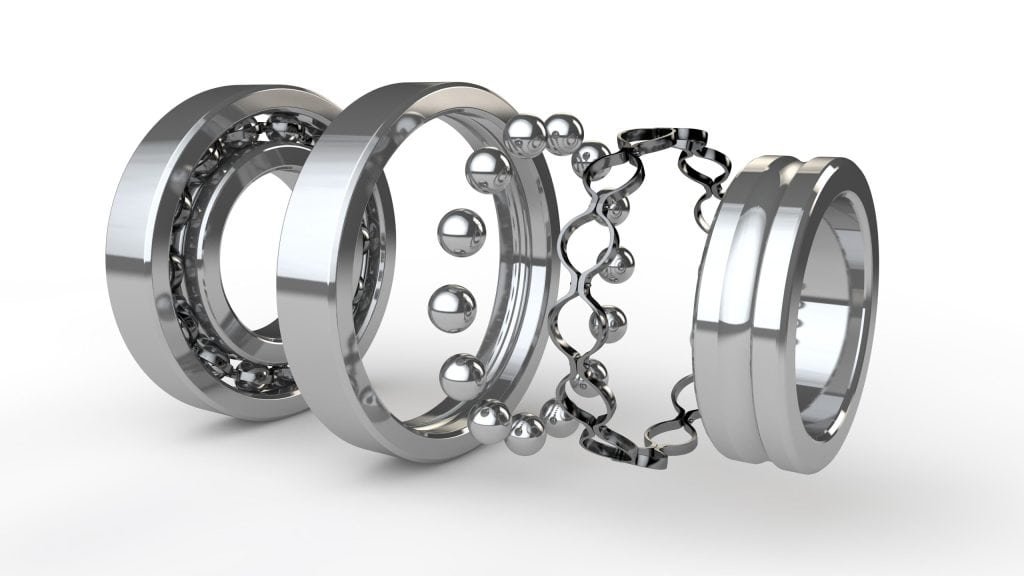
These types of bearings are one of the widely used rolling-element type bearings in several industries. Ball bearings are very versatile and are able to tolerate radial and axial loads. These bearings are made of a series of balls encapsulated in two rings. The rings are called races. The inner one is fixed to the rotating shaft, whereas the outer one is placed inside an immovable housing. This distinct design enables the ball bearings to support the shaft during its rotation. Since metal-to-metal rotation causes friction, the design reduces the friction.
These bearings have various applications in different industries, including household appliances, automobile wheels, small machinery, electric motors, and large industrial equipment. They are not only efficient in handling radial loads but also withstand axial loads. That’s why they are used in different machinery.
Thrust Bearings

They are particularly suitable for supporting axial loads, where the force is applied at 180 degrees or parallel to the rotational axis. It finds its application in most of the machinery where there is a need of keeping the components in place during rotational movement across the axis. Their rolling elements are either cylindrical or ball-shaped and placed inside two races. This unique configuration makes them ideal for the automotive industry in their transmission systems where the gears need to be supported axially and can rotate very freely.
These types of bearings are very versatile and handle sudden axial load spikes quite well. Why do these sudden spikes happen? Because of the presence of vertical shafts and hoists in the transmission systems and gears. You can also find thrust bearings in the aerospace industry as an essential part of jet engine components because high-precision axial motion is required for that.
Ball Bearing vs Thrust Bearing: Comparison

Let’s move to the in-depth comparison between ball bearing vs thrust bearing through the table below:
| Characteristics | Ball Bearings | Thrust Bearings |
| Primary Load | Radial load that is perpendicular to the axis | Axial load that is parallel to the axis |
| Secondary Load | Able to tolerate axial load to some extent | Able to tolerate radial load to some extent |
| Design | Ball-shaped, with balls as rolling elements | Flat and usually circular |
| Applications | Household appliances and electric motors | Automobile transmission systems and jet engine components |
| Efficiency | Highly efficient for radial load handling | Highly efficient for axial load handling |
| Complexity | More complex because of the dual load capacity | Very simple and space-saving |
Now, we will move towards the advantages and disadvantages of ball and thrust bearings. It will help you give even more idea about the two bearings, so you purchase them according to your particular application and needs.
Advantages and Disadvantages
Ball bearings and thrust bearings play an important role in decreasing friction between different moving parts of the mechanical system to ensure smooth movement and functioning. Both of these bearings have widespread applications in various industries. They have multiple advantages, but have some disadvantages or limitations too.
Advantages of Ball Bearings
- They have good versatility as they can be used to tolerate axial and radial loads, and hence perfect for different applications.
- They have low friction. It is because of their design, as the contact area between the races and balls is minimal. It helps lessen friction, resulting in smoother functioning and achieving higher speeds.
- Ball bearings are quite durable. They can keep their shape and form for an extended period of time if you maintain them well, even in harsh conditions.
- They are cost-effective and comparatively more affordable to manufacture and replace than their other counterparts.
- These bearings are standardized for different application usages, which makes them easily replaceable compared to other types of bearings.
- Since they have low friction, they need less energy. This makes the overall system much more energy-efficient.
Disadvantages of Ball Bearings
- These are sensitive to misalignments, even the slightest misalignments can reduce their lifespan and they wear off with that.
- Their load-carrying capacity is lower than that of other bearing types, particularly roller bearings.
- During higher speeds, the ball bearings produce noise because of the movement of balls inside the races.
- You need to lubricate the bearings regularly and take care of their maintenance. Otherwise, they have a risk of wearing off under heavy loads.
Now, we will talk about the advantages and disadvantages of the thrust bearings.
Advantages of Thrust Bearings
- Thrust bearings have exceptional axial load handling capability. They perform very well under circumstances where the load is along the axis.
- Because of their flat design, these bearings are very compact and save a lot of space where space is constrained.
- They handle axial loads very well and, hence, produce very little heat compared to the other bearing types.
- These bearings come in different subtypes to cater to different types of situations. For example, ball thrust bearings for low speed and tapered roller thrust bearings for high speed applications.
- Thrust bearings offer high precision and control in machinery that needs accurate axial movement, including aerospace equipment and automotive transmission systems.
- They are easy to maintain and replace because of their simple, compact, flat design.
Disadvantages of Thrust Bearings
- Though they are excellent for handling axial loads under various circumstances, they cannot perform as good while handling radial loads. You need to design them specifically for radial load applications. It limits its applicability.
- These bearings may slip within the assembly at higher speeds and extreme loads. It affects their performance and durability.
- In case of poor lubrication and extreme conditions, they may wear off, though their design is extremely simple and easy to maintain.
- Just like ball bearings, thrust bearings are also sensitive to misalignments. It reduces their functionality and reliability.
- Some thrust bearing types, such as tapered roller thrust bearings, are costly compared to other bearing types as they manage heavier loads and extreme conditions.
Applications
As mentioned, ball and thrust bearings are part of different mechanical components in various industries. Ball bearings are good for handling axial and radial loads, and that is why they are more versatile. On the other hand, thrust bearings are used where axial load is the primary load, and they can tolerate even higher speeds as well.
Here are some applications of ball and thrust bearings for you to understand which one to choose based on durability, flexibility, and performance.
Applications of Ball Bearings
| Application | Description |
| Electric motors | They support motor shafts to make them rotate seamlessly without friction. |
| Automotive wheels | These facilitate smooth wheel rotation and are present in the hub wheels of cars and trucks. |
| Household appliances | They are present in washing machines refrigerators, and dryers to handle moving part’s movement and reduce wear. |
| Industrial machinery | These bearings ensure smooth functioning by handling radial and axial loads in different industrial machinery. |
| Aerospace | They are important for different aircraft components’ operation, especially control mechanisms and actuators. |
| Computer fans | Ball bearings operate fans without noise with efficiency. Hence, important for cooling components. |
Applications of Thrust Bearings
| Applications | Description |
| Automotive transmission | These bearings support gears in automotive transmissions, which enable them to operate smoothly and efficiently. |
| Aerospace applications | They are present in the control system of aircraft to manage axial loads linked to flight adjustments and components of jet engine. |
| Marine propulsion | Thrust bearings are in the ship propeller shafts. They allow the propeller to push the vessel forward efficiently and smoothly by managing the axial thrust. |
| Vertical shaft applications | They are used in motors and vertical pumps since there is a load primarily in the axial region. |
| Heavy machinery | They support the digging and lifting of bulldozers and excavators by managing axial loads effectively. That’s why you found their application in different construction equipment. |
Conclusion
Ball bearings and thrust bearings are both widely used bearings in multiple industries. So, which one to choose between ball bearing vs thrust bearing? The answer is simple. If your application requires handling of axial and radial loads, pick the ball bearings. If the application is operating at higher speeds and predominantly axial load is present, choose the thrust bearings.
For any bearing-related information, contact BYWB Bearing. We are leading bearing manufacturers and suppliers available to cater to your bearing needs 24/7. So, contact us now!
