
Bearings are responsible to carry or tolerate high loads in multiple mechanical systems in various industries. You probably have only heard of steel bearings. However, there is another type of bearing called ceramic bearings.
These bearings perform high load and high speed functions but are different from the steel bearings. So, what they are and how do they differ from the conventional ones? We will tell you everything related to ceramic bearings. Their advantages, disadvantages, applications, and so much more.
What is a Ceramic Bearing?

Ceramic bearings are important industrial bearings having dozens of applications. Their rolling element is made of ceramic material which is entrapped in an outer and inner ring of ceramic too (full ceramic). In conventional bearings, the rolling element along with the rings is made of steel.
Since ceramic materials vary, these bearings can be used for hybrid conditions and hence have wide range of applications. There are different manufacturers that make bearings with ceramic races, but they are not that reliable and damage easily.
The common materials used for the making of ceramic bearings rolling elements are silicon carbide (SiC), silicon nitride (Si3N4), zirconium oxide (ZrO2), and aluminum oxide (Al2O3). All these ceramic materials are very durable and tough to break, have low friction, and resist corrosion far better than the other bearings.
However, two of the materials (silicon nitride and zirconium oxide) are more brittle even they they are very tough, so there is a chance that they crack in extreme conditions. The ceramic bearings are more expensive than the steel ones because they are more appropriate for high speed applications.
Ceramic vs Steel Ball Bearings: Which One Do You Need?
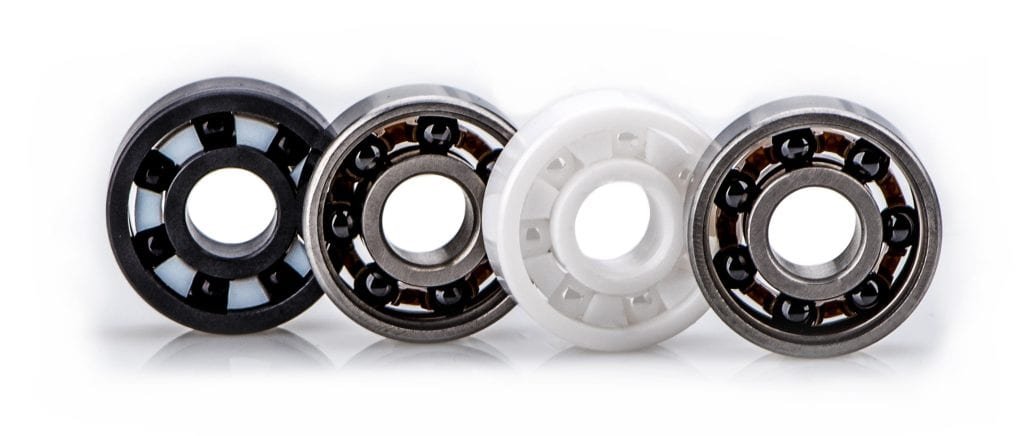
As mentioned above, ceramic bearings are different from steel ball bearings. They both serve almost similar purposes but they have composition differences, Also, they differ in advantages. Each has its unique features that make them both usable for several applications.
We have made a comparison table between ceramic and steel ball bearings. It will help you understand what suits you more according to your project needs.
| Ceramic Bearing | Steel Ball Bearing |
| The rolling resistance is considerably low because of increased smoothness. | The rolling resistance is present because steel ball bearings are not very smooth. |
| It has more dimensional stability. | It has less dimensional stability. |
| The load (axial and radial) is evenly distributed among the ceramic rolling elements. | The load (axial and radial) is not evenly distributed among the ceramic rolling elements. |
| The ceramic density is 40% which is less compared to steel which enables high speed applications. | Steel is denser, that’s why steel ball bearing is not ideal for very high speed applications. |
| It is more rigid than steel ball bearing. | The steel ball bearing is less rigid. |
| These bearings have high resistance to corrosion. | These bearings have a bit less resistance to corrosion. |
| The ceramic rollers move much faster for high speed applications. | Steel rollers don’t move faster than ceramic rollers. |
| They are non-conductive bearings. | Steel bearing is not entirely non-conductive. |
| Such bearings are lighter in weight as compared to steel bearings. | They are a bit heavier than ceramic ones because of steel material composition. |
What is the Disadvantage of Ceramic Bearings?
Well, there are multiple benefits of ceramic bearings, and they are superior to steel ones. However, there are drawbacks also. One of the biggest flaws is that ceramic materials are brittle. Although they are very tough, they crack and break easily. Hence, their ability to withstand loads is less compared to steel ball bearings.
Some other disadvantages of these bearings are mentioned below:
- These bearings are more costly than steel bearings because of the materials and processes involved in their manufacturing.
- Being expensive, these types of bearings are less accessible for common applications.
- Unlike steel, ceramic materials are more brittle and can break pretty easily.
- For heavy industrial applications, they cannot bear adequate load compared to steel bearings.
- When you use these bearings with steel components, there will be thermal expansion compatibility issues between the two different materials. It leads to faster damage in case of higher temperatures.
- They can produce louder noise compared to steel, especially if the lubrication is not properly maintained.
- In high vibration activities, ceramic bearings don’t perform as best as steel ones.
Applications for Ceramic Bearings

Ceramic bearings have different uses and can be seen in various applications. Let’s look at a table to learn about the applications and which industries they can be used in.
| Application | Description |
| Aerospace industry | Spacecrafts, parts of aircraft engines, satellites, and others may have ceramic bearings to bear high speed. |
| CNC machines | These bearings can be found in the spindles of CNC machine tools. |
| Automobile industry | You can use these types of bearings in electric vehicles, racing cars and other vehicles. |
| Hard drives of computers | They are used as computer hard drive bearings. |
| Medical tools | Certain OT devices, dental drills, and MRI machines, besides others have ceramic hybrid bearings. |
| Industrial machinery | These bearings are frequently used in pumps, turbines, and spindle operating at high speed. |
| Food & beverages industry | You can see its application in conveyor belt systems and food processing equipment and machines. |
| Cycle & sporting equipment | Bicycle wheel hubs and pedals are the two most common areas where ceramic bearings are used. |
| Wind energy industry | The generator of wind turbines has ceramic type bearings for corrosion resistance. |
Do You Need Any Special Grease for Ceramic Bearings?
No, you do not need any kind of special grease for these bearings. Such bearings have the ability to perform well in all types of conditions, whether dry or lubricated. You can use them without applying grease because of their rigidity, strength, and high wear and corrosion resistance.
There are so many manufacturers in the market that advertise these bearings as maintenance-free or self-lubricating. Though they need less maintenance because of exceptional ceramic materials, you cannot claim that they are entirely maintenance-free. They need a little bit of lubrication from time to time or as needed.
Are Full and Ceramic Hybrid Bearings the Same?
No, they are not exactly the same. They serve the same purpose, but their applications vary a little. How? Let’s see:
| Attributes | Full Ceramic Bearings | Ceramic Hybrid Bearings |
| Composition | These bearings are entirely made of ceramic materials, including rolling elements and outer and inner rings. | Their rolling element is made of ceramic only, whereas the outer and inner rings are made of stainless steel. |
| Common materials are silicon carbide (SiC), silicon nitride (Si3N4), zirconium oxide (ZrO2), and aluminum oxide (Al2O3). | The rolling element is mostly made of silicon nitride (Si3N4). | |
| Performance | They are highly corrosion-resistant, lightweight, and non-conductive. | They have more high-load bearing capability and, hence, are more resistant to impacts. |
| Temperature | These bearings can work excellently under higher temperatures 1800°F. | Because of steel components, these bearings can operate best up to 350°F. |
| Weight | They are extremely lightweight since there is no steel component. | Compared to its full counterpart, this bearing is heavy but still a lot lighter than actual steel bearings. |
| Price Value | They are slightly on the expensive side because of the costly ceramic materials and production process. | Cheaper than full ones but still more expensive than original steel ball bearings. |
| Usage | Used for very strict, highly specialized applications and environments. | Used for common applications. |
Ceramic Bearings vs Steel Skateboard
When you talk about the skateboard bearings, you cannot ignore the importance of 608 bearings. These bearings are neither ceramic bearings nor steel ones. It is basically the dimension or size of the bearing that is mostly used in skateboards and other rolling devices.
They have an inner and outer diameter of 8 mm and 22 mm, respectively with total width of 7 mm. You can either get them in ceramic or steel, it’s up to you. So, what’s the difference between them?
Ceramic 608 bearings have more speed because of smooth surface, are lightweight, and pretty durable. Their maintenance is less since they require less lubrication. But they are more are more likely to crack and break and cannot absorb impacts as great as steel ones. Besides, they are expensive.
In contrast, steel 608 bearings tolerate impacts very efficiently and are entirely made of steel components. You can use these bearings for advanced skateboards where the skaters grind and perform tricks. Their price is affordable, and that’s why skateboarders prefer this type. The drawback is that these bearings need regular maintenance and lubrication. Besides, they are not better resistant to corrosion.
Conclusion
Ceramic bearings are the best for high speed and high load activities. You can find their uses in industries like aerospace, automotive, wind energy, medical equipment, cycle & sporting tools, machinery, and so many other industries. They don’t need regular maintenance and lubrication. So, need bearing assistance? Contact BYWB Bearing for all your bearing needs. You can reach out to us 24/7 regarding any bearing query or assistance. We are the experts in bearing manufacturing and supplying across China. So, hurry up. Contact us right now!
