
Lifting, lowering, and moving heavy weights require forklifts to operate under high pressure with steady reliability, which is provided by forklift mast bearings. These special bearings support the forklift mast for its smooth vertical movement while supporting massive radial and thrust loads.
The mast bearings are robust and durable and guide the carriage of the forklift through the grooves with a minimum amount of friction, which in turn provides stability during continuous use.
Fork truck mast bearings are different from any other bearings. They are uniquely made to take into consideration heavy wear resulting from heavy-duty usage. Let’s explore what a forklift mast bearing is, its types, and how to replace it.
What is a Forklift Mast Bearing?

It’s basically a bearing in a forklift mast assembly that allows the up and down movement of the mast with its carriage. These bearings are designed to cope with heavy loads and stresses to which forklifts are subjected daily, while providing smooth and controlled lifting and lowering of loads. Built to take heavy radial and some thrust loads, mast bearings add stability and longevity to the forklift’s lifting mechanism.
There are five major kinds of forklift mast bearings designed to handle particular needs of load-carrying and general operating conditions. The common features of fork truck mast bearings are:
Heavy-Duty Load Carrying Capacity
These bearings have hardened outer rings to support the extreme radial loads which a forklift has to bear in lifting and moving materials. Quite often, the outer rings act as guides. They also support movement along the mast channels.
Misalignment Resistance
The bearings of the forklift mast are made in such a way that small misalignments can be resisted during heavy usage. This keeps the mast stable and nullifies any possible wear and tear that might come its way from constant changes in direction.
High Durability
These bearings use materials and designs that can sustain high levels of stress. As such, they are highly resistant to wear and abrasion from multiple uses. Long life is quite critical here; failure of a bearing can completely hamper the efficiency and safety of the forklift.
Minimum Friction
Since the mast bearings are designed to have only a minimum friction, it makes the energy required for operating. The up and down motion is reduced, which will, in turn, enhance the efficiency of the forklift. The low-friction movement also reduces wear on the mast channels, adding years to the assembly’s lifespan.
Ease of Maintenance
Most mast bearings are designed in such a way that they are easily accessible and replaceable. Therefore, operators and technicians are in a position to perform maintenance without causing much disassembly of parts. Typically, a regular inspection and lubrication will keep this kind of bearing in good condition.
All these features make forklift mast bearings a very simple element of the entire capability of the forklift to move such heavy loads around safely and efficiently in many industrial processes.
Mast Bearing Types
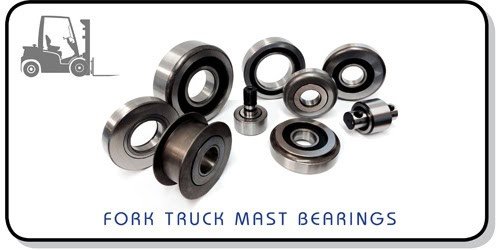
There are four major types of forklift mast bearings, each designed to perform certain roles within the mast assembly. These bearings cooperate in providing vertical movement and lateral stability to the mast, thus allowing smooth operations to be carried out with controlled loads.
Each of these types is specifically designed to bear particular kinds of load, directional stresses, and requirements concerning alignment that become necessary for safe and efficient operations of the forklift.
1. Mast Guide Bearings
The mast guide bearings are the main elements responsible for the smooth up-and-down movement of the mast along the channels of a forklift. They contain heavy-duty outer rings and rolling elements that bear the vertical load and facilitate alignment of the mast with very minimal friction.
It provides guidance to the carriage as it moves along the mast channels, hence reducing wear and allowing the lifting function to become stable. Constructed of rigid materials, they are able to resist heavy radial forces common in intensive forklift applications while maintaining a smooth steady lift path.
2. Carriage Bearings
Carriage bearings are located in the carriage itself, that portion of the mast assembly that actually supports the forks in their vertical movement. These bearings are usually smaller than mast guide bearings but perform a very important function in load weight support provided to the forks.
Carriage bearings allow for the forks to maintain alignment during racking which prevents wobbling at the carriage and provides added stability. They also provide a smooth surface on which the carriage can sit for reduced friction and smoother vertical movement.
3. Side Thrust Rollers
Side thrust rollers are designed to manage lateral or sideways forces exerted on the mast. This movement of a forklift in maneuvers and making turns with a load can make the mast shift slightly from side to side, thus creating lateral stress.
Side thrust rollers absorb the sideways forces and stabilize the mast to avoid misalignment. They can be compact and usually side-mounted on the mast structure so that the forklift is able to make tight maneuvers without the mast channels getting in the way or damaged.
4. Chain Roller Bearings
The chain roller bearings support chains for the movement of the vertical carriage. Situated in the chain pulley system, these bearings engage tension and load from lifting and lowering the carriage. Chain roller bearings are designed to rotate with minimal resistance.
Hence, it cuts down energy consumption by the carriage while raising it and promotes longevity to the chain and pulley components involved. Chain roller bearings provide great load handling with high endurance, and this contributes a great deal to the smooth and efficient lifting action of a forklift mast.
5. Combined Roller Bearings
Combined roller bearings are one type of specialty assembly that incorporates a mast guide bearing with a built-in side thrust roller. This special combination permits the bearing to control both the vertical and lateral movement of the mast in one integrated unit. The heavy vertical loads are managed by the mast guide component, smoothly guiding the forklift carriage along the mast channels.
In the meantime, the side thrust roller absorbs lateral forces, which occur in the event of a forklift turn or when managing a load capable of shifting the mast to one side.
All these five types of bearings have an important role in the functioning of the forklift mast while sharing the load to realize safe and reliable performance under very demanding conditions.
Forklift Mast Bearing Replacement

The bearings in a forklift mast play a vital role as devices that ensure the mast and carriage move smoothly vertically so that the load can be lifted and lowered efficiently.
These bearings tend to get worn or damaged over time, which will lead to poor performance and may pose a safety risk. Regular inspection of the mast bearings and timely replacement is quite essential in ensuring high performance levels in a forklift.
Steps Involved
Prepare the Forklift
Lower the forks to the ground and then lean the mast forward to create better access to the bearings.
Ensure that the forklift is placed on firm and level ground, with the parking brake engaged.
Disconnect the power source of the forklift to avoid any accidental operation while maintenance is being performed.
Lock the Mast
Raise the mast assembly and support it with an appropriate lifting device-a hoist or another forklift.
Loosen the chain anchors to release tension from the chains.
Mast Disassembly
For several forklifts, you need to remove bolts or locking pins in order to take away mast rails.
Slide the mast rail carefully with the bearings exposed.
Remove the Old Bearings
Take a bearing puller or something similar and carefully draw out worn or damaged bearings from the mast assembly.
Remember the positioning and orientation of each bearing in order for correct installation of the new ones.
Inspect and Clean All Components
Clean the mast assembly of all debris and old lubricant. Inspect the mast rails for wear and damage, among other components, and replace as needed.
Install New Bearings
Apply a thin layer of grease to the bearing seats for ease in having the bearings go on.
Press new bearings on properly, taking care to ensure they are seated and aligned.
Reassemble Mast
Slide mast rails back into assembly, aligning with new bearings.
Secure rails with original bolts or locking pins.
Reconnect Chains and Test
Reinstall the chain anchors and adjust the tension of the chains as prescribed by the manufacturer.
Reconnect the forklift power source.
Conduct tests on the forklift functions of lift and lower for smooth operations.
Mast Roller Bearing Catalogue (Mast Bearing Size Chart)
| Part Number | OEM | Drawing No |
| MG207FFM | BCA | 01A |
| MG305DD | BCA | 01A |
| MG305DDA | BCA | 01A |
| MG306DD | BCA | 01A |
| MG306DDB | BCA | 01A |
| MG307FF | BCA | 01A |
| MG307FFA | BCA | 01A |
| MG307FFB | BCA | 01A |
| MG307FFH | BCA | 01A |
| MG307FFK | BCA | 01A |
| MG307FFM | BCA | 01A |
| MG307FFP | BCA | 01A |
| MG308FFA | BCA | 01A |
| MG308FFE | BCA | 01A |
| MG308FFU | BCA | 01A |
| MG309-DOMED | BCA | 01A |
| MG309DDA | BCA | 01A |
| MG309DDB | BCA | 01A |
| MG311ZZA | BCA | 01A |
| MGA309DD | BCA | 01A |
| 304DDK | BCA | 02A |
| MG207FF | BCA | 02A |
| MG207FFA | BCA | 02A |
| MG207FFB | BCA | 02A |
| MG208FF | BCA | 02A |
| MG209DD/MOD | BCA | 02A |
| MG305DDY | BCA | 02A |
| SX0731PX1 | BCA | 02A |
| 449-032 | BCA | 07A |
| MG207FFH-MOD | BCA | 07A |
| MG207FFK-MOD | BCA | 07A |
| MG207FFP | BCA | 07A |
| MG207FFU | BCA | 07A |
| RS449032 | BCA | 07A |
| MG206FFA | BCA | 09A |
| MG206FFPA | BCA | 09A |
| MG206FFZ | BCA | 09A |
| MG207FFJA | BCA | 09A |
| MG307FFE | BCA | 09A |
| MG5211VR | BCA | 24A |
| MG5208KFF | BCA | 29A |
| MG5208VFF | BCA | 29A |
| MG5208VFFA | BCA | 29A |
| MG5208VFFB | BCA | 29A |
| MG5208VFFE | BCA | 29A |
| MG5208VVFA | BCA | 29A |
| MG308FFW | BCA | 30A |
| MG206FFH | BCA | 46A |
| MG206FFK | BCA | 46A |
Conclusion
Forklift mast bearings are essential bearings that help forklifts to cope with heavy loads and stresses in different applications. They have multiple types, each with its own feature and benefit. Replacing forklift mast bearings needs to be accurate to ensure the machine is working properly. Contact BYWB Bearing for all bearing needs. We are experts in the industry and available 24/7 for your assistance.
