
In various mechanical equipment, oil seals prevent oil leakage and dust infiltration. Usually, they consist of a metal skeleton and a rubber lip attached tightly to the rotating shaft.
There are many types of Oil seals, but here in this article we are going to talk about TC, TB, TCY, and SC seals, this guide is about the difference between them which will help users select the right option for their specific machinery, but first let’s see what are Oil seals?
What Are Oil Seals?

Many names have been given to oil seals, including shaft seal, dirt seal, grease seal, lip seal, and many others. They maintain cleanliness in rotary shaft machinery by preventing oil leaks and preventing dirt, dust, and water from entering.
It’s purpose is to seal the equipment’s moving and stationary parts. Moreover, it prevents impurities from getting inside the machine and shortens its lifespan. The most crucial role of an oil seal, however, is protecting rotating shaft bearings such as ball, sleeve, and roller types.
Types of Oil Seals
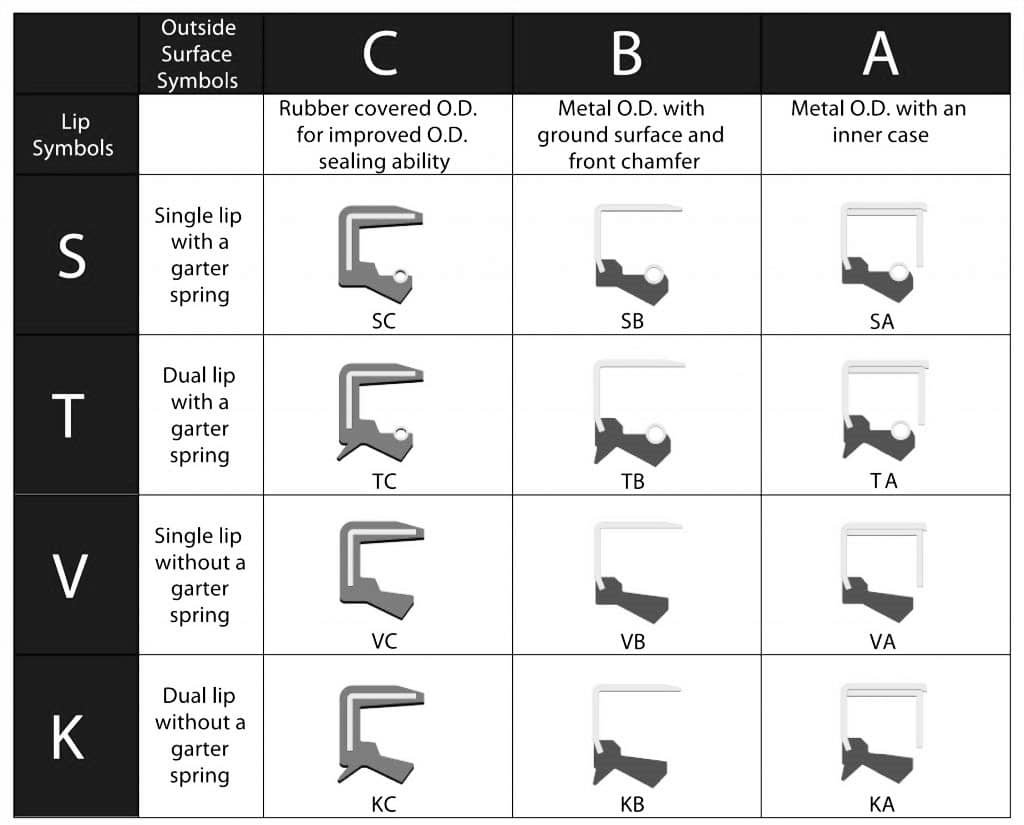
There are many types of oil seals, but in this article, I will focus on 4 common types: TC, TB, TCY and SC.
TC and TB oil seals are are almost similar, they have a single lip and a spring that enhances the sealing pressure. The difference between them is that TC oil seals have a dust-proof lip on the outside and a rubber-coated metal case, while TB oil seals do not have a dust-proof lip and have a metal case without rubber coating. TC oil seals are suitable for agricultural machinery, construction equipment, etc. Where dust or dirt does not exist, TB oil seals are suitable, such as gearboxes, pumps, motors.
TCY and SC oil seals are also similar. They have a single lip and a spring that enhances sealing pressure. TCY oil seals have a dust-proof lip on the outside and a double metal case with rubber coating on both sides, while SC oil seals have rubber-coated metal cases without dust-proof lips.
A TCY oil seal is best used in hydraulic systems, compressors, and other applications with high pressure or high temperature in the oil chamber. Water pumps, fans, etc., require SC oil seals because they have low pressure or low temperature in the oil chamber.
1. TC Oil Seals
Design:
This oil seal has a dual lip design, with the inner lip retaining the lubricant and the outer lip preventing contaminants from entering. The TC symbol indicates that the seal is made from elastomeric materials, such as Nitrile (Buna-N), which provides high quality oil, grease, and temperature resistance.
Applications:
TC oil seals are most widely used in different automotive and industrial applications, including engines, transmissions, and gearboxes.
Advantages:
- Prevents lubricant leaks.
- Temperature-resistant and durable.
- Provides dirt, dust, and moisture protection.
2. TB Oil Seals
Design:
The TB oil seal is same as the TC seal, but it is designed differently. It is incorporated with a metal case that add strength and stiffness to the TB seal, making it suitable for applications involving mechanical stress. The lip makes direct contact with the shaft to create a tight seal.
Applications:
TB seals provide moderate levels of oil retention and contamination protection in industrial machinery, automotive applications, and agricultural equipment.
Advantages:
- Steel casing improves structural integrity.
- Moderate pressure seals well.
- Prevents external contaminants from entering.
3. TCY Oil Seals
Design:
A TCY oil seal combines the features of both TC and TB seals. Like TC seals, it has a double lip design, but one thing that differs is that it has a metal casing. TCY seals provide robust flexibility and strength at the same time, making it ideal for many applications.
Applications:
Often used in hydraulic systems, automotive engines, and industrial equipment.
Advantages:
- Enhances sealing and durability.
- Resistant to external contaminants.
- Ideal for High-speed and stable temperature.
4. SC Oil Seals
Design:
Due to the single lip design and lack of a metal casing, SC oil seals are lighter and more flexible than TC, TB, and TCY seals. The softer elastomeric materials allow them to adapt better to shaft sizes and surface irregularities.
Applications:
Mostly, SC seals are used in low-pressure applications where high flexibility and reusability are needed, such as in household appliances.
Advantages:
- Easy to install, lightweight, and flexible.
- Seals well at low pressures.
- Cost-effective for applications that do not require high durability.
Purpose of Oil Seal
- Keeping the lubricant in the designated area by acting as a physical barrier.
- In spite of high oil pressure, prevent lubricating oil from leaking outside.
- Maintain a barrier between lubricating oil and debris, contaminants, and other outside elements.
How to Choose Your Right Oil Seals?

When selecting between TC, TB, TCY, and SC oil seals, several factors should be considered:
Application Evaluation
Consider TC or TCY seals for high-speed or high-pressure applications. For conditions with minimal exposure, consider TB or SC seals.
Review Material Compatibility
A seal’s life can be extended by choosing a material with the right resistance. Nitrile, for example, works well with petroleum-based lubricants, while other applications require specialized materials that resist chemicals.
Consider Design Features
Select a seal with the necessary features, such as dual lips or reinforced casings. For example:
Dual-Lip Seals (e.g., TC, TCY): Offer extra protection against dirt and contaminants.
Single Lip Seals (e.g., SC): Lightweight and simple, suitable for less demanding applications.
Conclusion
At the end, your choice of bearing seal may be affected by a number of variables, including the maximum temperatures, and lubricant requirements. Your application will specify the type of bearing you need, the amount of material needed, and other factors.
However, in order for your bearings to function effectively, you should choose the right seals, and if you still find it difficult, BYWB bearings experts will work with you to identify the bearings and bearing seals that provide the best, most affordable solution for your application, environment, and final product.
