
Selecting the right bearing for an electric motor can be the difference between a smooth operation and a costly breakdown. In fact, research from the Electric Power Research Institute found that bearing failures account for nearly half of all motor failures. This makes choosing the best bearing not just a technical decision but a critical financial strategy. So, how do you navigate multiple options available to ensure your electric motors are both efficient and reliable? Let’s dive into what makes a bearing stand out in the world of electric motors.
What is an Electric Motor Quality Bearing?

Electric Motor Quality (EMQ) bearings are specifically designed to enhance the performance and reliability of electric motors. These bearings are engineered to higher precision standards to ensure they facilitate smoother and quieter operation, which is critical in environments where noise reduction is valued.
EMQ bearings are not only about noise reduction; they also support higher load capacities and offer longer service lives compared to standard bearings. This is particularly important in electric motors, where bearing failure can lead to significant downtime and repair costs. The construction of EMQ bearings includes features such as improved raceway finishes, tighter dimensional tolerances, and special lubrication that cater to the high-speed and high-precision requirements of electric motors.
These bearings find applications across various motor types, including:
- AC and DC motors:Used in a range of industrial and consumer applications where reliable speed and torque control are necessary.
- Gear motors:These require robust bearings that can handle the additional strain from gear reduction.
- Brush and brushless motors:Used in applications requiring high efficiency and durability.
- Stepper motors:Common in precision control applications, where the bearings must support precise movements without failure.
Each type of bearing used in these motors—such as angular contact, cylindrical roller, needle roller, spherical roller, and tapered roller bearings—is chosen based on the specific operational needs, such as load direction and speed requirements. This careful selection ensures optimal performance and longevity, making EMQ bearings a critical component in the design and function of electric motors.
Types of Bearings Used in Electric Motor

Electric motors commonly use a variety of bearings, each designed to accommodate different mechanical and operational stresses. Here’s a detailed look at the types of bearings used in electric motors:
1. Single Row Radial Ball Bearings
These bearings are widespread in electric motors due to their design, which includes an inner and outer ring with a set of steel balls in between. They primarily handle radial loads, making them suitable for low to moderately loaded applications like small appliances and fans.
2. Deep Groove Ball Bearings
A subtype of radial ball bearings, these are designed for high-speed applications. They have a larger contact area between the balls and raceways, which makes them ideal for high-speed operations in electric motors found in various appliances .
3. Angular Contact Ball Bearings
These bearings are essential for applications requiring support for both radial and axial loads. Their design allows them to handle combined loads, which is crucial in applications where precise positioning is needed or where the shaft experiences both axial and radial forces, such as in machine tools and robotics.
4. Self-Aligning Ball Bearings
Known for their ability to accommodate misalignment between the shaft and housing, these bearings are used in electric motors that might experience shaft misalignment due to assembly variances or operational conditions. They help minimize friction and wear caused by misalignments.
5. Spherical Roller Bearings
Designed to handle heavy radial and axial loads, these bearings are suitable for large industrial electric motors used in applications like conveyors and crushers. They can also accommodate misalignment and are known for their robust performance under heavy load conditions.
6. Needle Roller Bearings
These bearings are distinguished by their cylindrical rollers, which have a high length-to-diameter ratio. They are used in compact electric motor designs where space is limited but high radial load capacity is required, such as in automotive starters or power tools.
7. Cylindrical Roller Bearings
Ideal for applications where thermal expansion of the shaft is possible, these bearings allow axial movement and can handle high load capacities. They are typically used in larger electric motors and are highly effective in settings where there’s potential for thermal expansion of the motor shaft.
8. Insulated Ball Bearings
These are crucial in preventing electrical pitting caused by electrical currents in generators and motors. The insulation, often a resin coating, prevents electrical currents from passing through the bearing, thus extending its life and reliability in electrically vulnerable applications.
Each type of bearing offers unique benefits and is chosen based on the specific requirements of the electric motor, such as load type, operational speed, and environmental conditions.
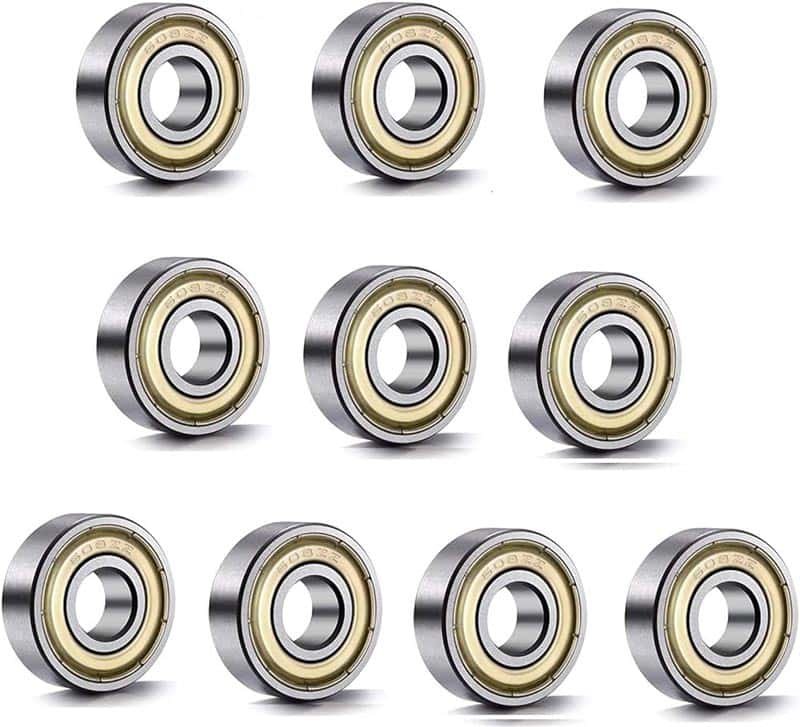
Electric Motor Quality Bearing Popular List
| Item number | Dimension IDxODxW (mm) | Quality Level | Grease type | |
|---|---|---|---|---|
| 6001ZZ | 12x28x8 | ABEC-5 | Chevron SRI-2 | |
| 6002ZZ | 15x32x9 | |||
| 6003ZZ | 17x35x10 | |||
| 6005ZZ | 25x47x12 | |||
| 6006ZZ | 30x55x13 | |||
| 6007ZZ | 35x62x14 | |||
| 6009ZZ | 45x75x16 | |||
| 6010ZZ | 50x80x16 | |||
| 608ZZ | 8x22x7 | |||
| 609ZZ | 9x24x7 | |||
| 6200ZZ | 10x30x9 | |||
| 6201ZZ | 12x30x10 | |||
| 6203ZZ | 17x40x12 | |||
| 625ZZ | 5x16x5 | |||
| 627ZZ | 7x22x7 | |||
| 6301ZZ | 12x37x12 | |||
| 688ZZ | 8x16x5 | |||
| 696ZZ | 6x15x5 |
The Bottom Line
The selection of the right bearing type is crucial for the optimal performance and longevity of electric motors. From handling radial and axial loads with angular contact ball bearings to accommodating misalignments with self-aligning and spherical roller bearings, each type has its specific role in ensuring the motor operates smoothly under varying operational conditions. Needle roller bearings and cylindrical roller bearings provide high radial load capacity in compact and large motor designs respectively, whereas insulated ball bearings offer protection against electrical pitting, which is crucial for maintaining the integrity of motor functions in electrically vulnerable environments.
For any organization looking to enhance motor efficiency and reduce downtime, understanding the characteristics and applications of different bearing types is fundamental. If you’re seeking reliable, high-quality bearings tailored to meet your electric motors’ specific needs, consider reaching out to BYWB Bearing. Contact BYWB Bearing today for all your bearing needs and ensure your motors run more efficiently than ever.
