
Angular contact ball bearings are a core component in modern machinery where combined radial and axial loads, high speeds, and high stiffness are required. This guide explains what they are, the common types, advantages, major applications, how to choose and mount them, and — at the end — compact size-chart templates for single-row and double-row angular contact bearings you can use as a quick reference.
What is an angular contact ball bearing?

An angular contact ball bearing is a rolling element bearing designed so the line of contact between the balls and raceways is at an angle to the bearing axis. That contact angle (commonly 15°, 25° or 30°) gives the bearing the ability to take axial loads in one direction in addition to radial loads. The larger the contact angle, the greater the axial load capacity (but usually lower limiting speed).
Key characteristics:
Asymmetric load capacity: single-row angular contact bearings are designed to support axial loads in one direction. Double-row and paired arrangements can support axial loads in both directions.
Preloadable: they are commonly mounted with axial preload to increase rigidity and reduce clearance.
High precision & high speed: commonly used where accurate running, low vibration and high RPMs are needed (machine tool spindles, pumps, automotive applications).
Types of angular contact bearings

Angular contact bearings exist in several formats and configurations. The main categories are:
1. Single-row angular contact ball bearings
The most common format.
Designed to support combined radial and axial loads in one axial direction.
Available in different contact angles (15°, 25°, 30° are typical).
Often used in matched pairs (back-to-back or face-to-face) to take axial loads in both directions.
2. Double-row angular contact ball bearings
Effectively two single-row bearings arranged to act like a single unit capable of supporting axial loads in both directions.
Often compact and space-efficient compared to two separate single-row bearings.
Good radial and axial load capacity, used in transmissions, gearboxes, differentials.
3. Paired single-row bearings (arrangements)
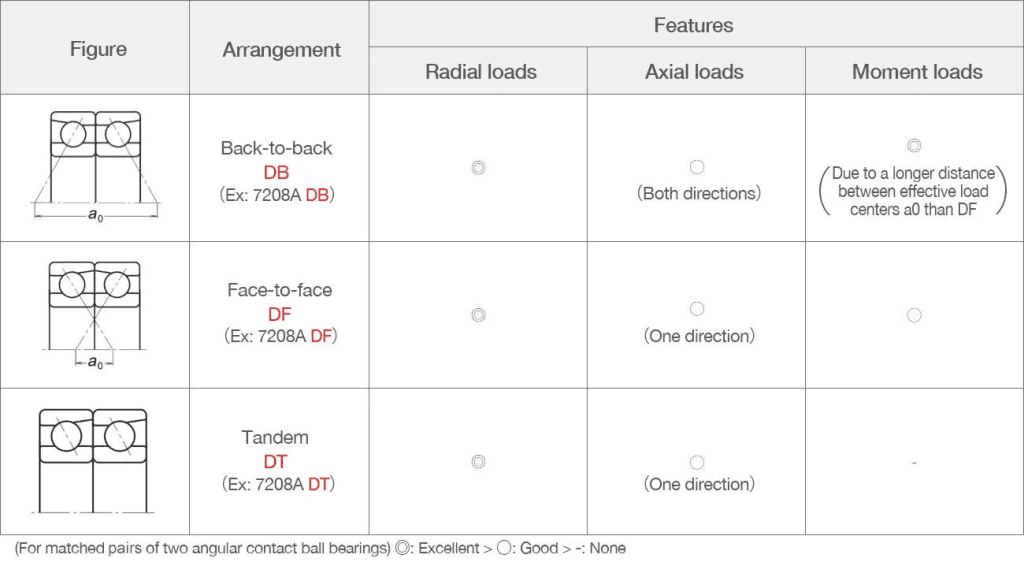
When designers need higher axial capacity in both directions while keeping the advantages of single-row units, they pair two single-row bearings in one of these arrangements:
Back-to-back (DB) — wide base, good moment (tilt) stiffness, stable under tilting moments.
Face-to-face (DF) — narrower base than DB, better alignment accommodation but less moment stiffness.
Tandem (DT) — bearings arranged to support axial load in the same direction (used when axial load capacity in one direction must be increased).
4. Variants & special types
Hybrid ceramic (Si3N4 balls + steel rings) for higher speed, lower weight, electrical insulation and longer life in some cases.
High-precision (ABEC/ISO P4, P2) angular contact bearings for spindles and precision equipment.
Sealed (2RS) and shielded (ZZ) versions — reduce contamination ingress / retain lubricant but may affect speed and heat dissipation.
Material variants: stainless steel for corrosion resistance; special steels and coatings for specific environments.
What are the advantages of angular contact bearings?
Angular contact bearings offer several design and performance benefits that make them the preferred choice in many precision and high-performance applications:
- Combined radial and axial load capability
Because of the contact angle, these bearings can carry substantial axial loads while still supporting radial loads — essential where the direction and magnitude of loads change or combine. - High rigidity when preloaded
Installing bearings with preload reduces clearance and increases stiffness — crucial for machine tool spindles, precision robots and instrumentation. - High-speed capability
Especially in high-precision, well-lubricated designs (and in hybrid ceramic versions), angular contact bearings run at high RPM with low vibration. - Flexibility of arrangements
Engineers can design bearing pairs (DB/DF/DT) to tune axial capacity, stiffness and alignment tolerance for the application. - Compact axial load support
Compared to thrust bearings, angular contact bearings supply axial support in a relatively compact radial footprint. - Precise axial positioning
With appropriate mounting and preload, angular contact bearings give predictable axial positioning — important for spindles and index mechanisms.
What are the applications of angular contact bearings?
Angular contact bearings are used across many industries. Typical applications include:
Machine tool spindles — high precision, high RPM, tight runout and stiffness required.
Automotive — transmissions, wheel hubs, clutches, pumps where combined loads occur.
Pumps & compressors — support radial and axial thrust from impellers.
Robotics & automation — joints and precision rotary stages needing stiffness and accurate axial positioning.
Aerospace & defense — actuation systems, gearboxes where weight, precision and reliability matter.
Medical devices — imaging equipment, dental drills and other high-speed, precision tools.
Electric motors & spindles — where radial and axial loads combine and space is limited.
Gearboxes & reducers — double-row or paired bearings provide compact axial support.
In general, whenever a compact bearing must handle a mix of radial and axial loading, angular contact bearings should be considered.
How to select and mount angular contact bearings (practical tips)
Contact angle selection
15° — higher speed, better radial capacity relative to axial.
25°–30° — greater axial capacity, lower limiting speed.
Choose based on the axial vs radial load ratio and speed requirements.
Material & precision
Use high-precision classes for spindles and low-vibration applications (ISO P4, P2 / ABEC 7, 9 equivalents).
Consider hybrid ceramic (Si3N4) balls for very high speeds or when electrical isolation is needed.
Pairing strategy
Use DB (back-to-back) where moment stiffness and accurate angular positioning under tilting moments are required.
Use DF (face-to-face) when alignment misfits could occur (more forgiving on shaft misalignment).
Use DT (tandem) to increase axial load capacity in a single direction.
Preload
Preload eliminates internal clearance and improves rigidity. Too much preload reduces life and increases heat; too little gives vibration and positional error. Follow manufacturer’s preload recommendations.
Lubrication
Proper lubrication (grease or oil) is essential — reduces wear, controls temperature and improves life. For high speeds, oil lubrication (circulation or oil mist) is frequently used.
Mounting
Use appropriate fits (shaft and housing fits) and follow recommended mounting procedures to avoid raceway damage. Avoid hammering the races; press only on the correct ring when fitting.
Alignment & shaft runout
Angular contact bearings tolerate less misalignment than deep groove bearings. Minimize shaft misalignment and bending to preserve life.
Size Chart – Single-Row Angular Contact Ball Bearings
7000 / 7200 / 7300 Series
Single-row angular contact ball bearings are commonly classified by series number, which indicates load capacity and bearing cross-section:
7000 series – Light series (high speed, lower load)
7200 series – Medium series (balanced speed & load)
7300 series – Heavy series (higher axial & radial load)
Typical contact angles: 15° (C), 25° (AC), 30° (B)
7000 Series (Light Series)
| Bearing No. | Bore (d) mm | OD (D) mm | Width (B) mm |
| 7000 | 10 | 26 | 8 |
| 7001 | 12 | 28 | 8 |
| 7002 | 15 | 32 | 9 |
| 7003 | 17 | 35 | 10 |
| 7004 | 20 | 42 | 12 |
| 7005 | 25 | 47 | 12 |
| 7006 | 30 | 55 | 13 |
| 7007 | 35 | 62 | 14 |
| 7008 | 40 | 68 | 15 |
| 7009 | 45 | 75 | 16 |
| 7010 | 50 | 80 | 16 |
Typical applications: high-speed spindles, CNC equipment, precision motors
7200 Series (Medium Series)
| Bearing No. | Bore (d) mm | OD (D) mm | Width (B) mm |
| 7200 | 10 | 30 | 9 |
| 7201 | 12 | 32 | 10 |
| 7202 | 15 | 35 | 11 |
| 7203 | 17 | 40 | 12 |
| 7204 | 20 | 47 | 14 |
| 7205 | 25 | 52 | 15 |
| 7206 | 30 | 62 | 16 |
| 7207 | 35 | 72 | 17 |
| 7208 | 40 | 80 | 18 |
| 7209 | 45 | 85 | 19 |
| 7210 | 50 | 90 | 20 |
Typical applications: machine tool spindles, pumps, compressors, servo motors
7300 Series (Heavy Series)
| Bearing No. | Bore (d) mm | OD (D) mm | Width (B) mm |
| 7300 | 10 | 35 | 11 |
| 7301 | 12 | 37 | 12 |
| 7302 | 15 | 42 | 13 |
| 7303 | 17 | 47 | 14 |
| 7304 | 20 | 52 | 15 |
| 7305 | 25 | 62 | 17 |
| 7306 | 30 | 72 | 19 |
| 7307 | 35 | 80 | 21 |
| 7308 | 40 | 90 | 23 |
| 7309 | 45 | 100 | 25 |
| 7310 | 50 | 110 | 27 |
Typical applications: heavy-duty spindles, gearboxes, industrial machinery
Size Chart – Double-Row Angular Contact Ball Bearings
5000 / 5200 / 5300 Series
Double-row angular contact bearings are equivalent to two single-row bearings arranged back-to-back, allowing them to support axial loads in both directions.
5000 Series (Light Double-Row)
| Bearing No. | Bore (d) mm | OD (D) mm | Width (B) mm |
| 5200 | 10 | 30 | 14 |
| 5201 | 12 | 32 | 15 |
| 5202 | 15 | 35 | 16 |
| 5203 | 17 | 40 | 17 |
| 5204 | 20 | 47 | 20 |
| 5205 | 25 | 52 | 20 |
| 5206 | 30 | 62 | 23 |
5200 Series (Medium Double-Row)
| Bearing No. | Bore (d) mm | OD (D) mm | Width (B) mm |
| 5207 | 35 | 72 | 27 |
| 5208 | 40 | 80 | 30 |
| 5209 | 45 | 85 | 30 |
| 5210 | 50 | 90 | 30 |
| 5211 | 55 | 100 | 33 |
| 5212 | 60 | 110 | 36 |
5300 Series (Heavy Double-Row)
| Bearing No. | Bore (d) mm | OD (D) mm | Width (B) mm |
| 5303 | 17 | 47 | 22 |
| 5304 | 20 | 52 | 22 |
| 5305 | 25 | 62 | 25 |
| 5306 | 30 | 72 | 27 |
| 5307 | 35 | 80 | 31 |
| 5308 | 40 | 90 | 34 |
| 5309 | 45 | 100 | 38 |
| 5310 | 50 | 110 | 41 |
Typical applications: automotive transmissions, industrial gearboxes, heavy pumps, agricultural machinery
Mounting examples & quick selection checklist
Mounting examples
Spindle: pair two single-row angular contact bearings back-to-back, preload to recommended spec, oil-lubricated circulation.
Gearbox input shaft: double-row angular contact bearing to save axial space while supporting bidirectional axial loads.
Pump shaft: single-row angular contact bearing with adequate axial capacity in the expected direction; consider tandem if axial load direction is uni-directional and large.
Selection checklist
- Determine radial & axial loads (magnitude & direction).
- Select contact angle to match axial/radial load ratio.
- Choose material / precision grade.
- Decide sealed vs open (contamination & lubrication strategy).
- Choose single vs paired vs double-row arrangement for bidirectional axial loads.
- Check shaft & housing fits and mounting method and plan for preload.
- Verify speed limits and lubrication method.
Confirm dimensions & dynamic/static load ratings on BYWB datasheet.
Conclusion
Angular contact ball bearings are versatile, high-performance components designed for combined radial and axial loading, high speeds, and high rigidity when installed with preload. Whether you choose single-row bearings (paired appropriately for bidirectional loads), double-row bearings for compact axial support, or hybrid ceramic designs for extreme speeds, the right selection depends on load ratios, required stiffness, speed, axial directionality and installation constraints.
Use the size-chart templates above as a planning aid — but always verify exact dimensions, preload data and load ratings with BYWB Bearing’s official product datasheets or ask BYWB’s technical team for a bearing selection and drawing for your specific application. If you’d like, I can convert these size-chart templates into a downloadable CSV or an engineering spec sheet formatted for procurement — tell me which nominal sizes you want included and I’ll produce it.
Short FAQ
Q: Can a single-row angular contact bearing take axial load in both directions?
A: Not by itself — single-row units are designed to take axial load in one direction. To support axial loads in both directions you pair two single-row bearings (DB or DF) or use a double-row bearing.
Q: Which contact angle should I choose?
A: Use smaller angles (15°) for higher speeds and better radial capacity; use larger angles (25°–30°) for higher axial capacity. Choose based on the axial/radial load ratio.
Q: How important is preload?
A: Very. Proper preload increases stiffness and reduces vibration and axial displacement. Too much preload shortens life and increases temperature; follow manufacturer preload specs.
Q: Sealed or open bearings?
A: Seals (2RS) protect from contamination and retain grease but may limit top speed and heat dissipation. Open bearings with oil lubrication are common in high-speed spindles.
