
As the name indicates, clutch release bearings are tiny but essential bearings used in the vehicle’s clutch system. These bearings make sure that the shifting of gear is very smooth so that your driving experience is as good as possible. Though these bearings are underrated and are not much talked about, they play a key role in all types of vehicles, whether manual or automatic.
Since the function of the clutch release bearing is important, we will let you know everything about the bearing. We will discuss what clutch release bearing is, its working, benefits, issues associated with it and maintenance tips.
What is a Clutch Release Bearing?
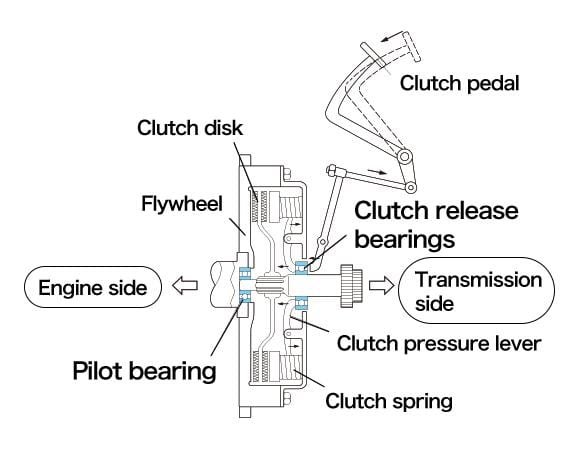
So, a clutch release bearing is an important component of any vehicle’s clutch system that helps with engaging and disengaging the clutch seamlessly. Such bearings are also called throw out bearings. Their placement is between the pressure plates and the clutch fork. Like any other bearing types, these bearings also make sure that the friction is reduced between the two moving parts, which in return, enables smoother gear shifting and increases the longevity of the whole clutch assembly. But, how do these bearings work?
How Does Clutch Release Bearing Work?

It’s inside the clutch assembly, so it works whenever the driver passes the clutch pedal in case of a vehicle with a manual transmission system. The exact steps of it’s working are:
Pedal pressed – when the driver presses the pedal of clutch, the release clutch bearing is pushed by clutch fork toward the pressure plates.
Contact with Diaphragm Spring – The pressure plate is then moved away from the clutch fork by the force applied by the release bearings on the contact diaphragm spring.
Disengagement of Engine Power – All of these movements split the clutch disc from the flywheel of the engine. It enables the driver to shift gears smoothly.
Pedal Released – when the driver releases its foot from the clutch pedal, the release bearing goes back to its original position. Resultantly, the clutch discs reconnect with the engine flywheel and continue transmitting power to the transmission.
Some Important Features
There are certain characteristics associated with clutch release bearings that make it unique and different from other types of bearings. Some of the important features of these bearings are:
Clutch release bearings are made of high-quality hardened steel or any ceramic materials to tolerate extreme heat and pressure.
Most of the clutch bearings are sealed to minimize the entrance of dust, moisture, and dirt, as these reduce wear and tear.
They have lubricated ball bearings or lubricating rolling elements to reduce friction as much as possible to make sure the operation is smooth.
Clutch systems of the vehicle generate heat during functioning, so the clutch release bearings are manufactured to tolerate high temperature and stress without descreading efficiency.
Such bearings have a longer service life so they last longer if you maintain them well enough.
Clutch Release Bearing Types

Just like other bearing types, there are several types of clutch release bearings. Each of these has a unique distinction and features that make them versatile to use for different applications. Here is a comparison table between the most common types of such bearings:
| Bearing Type | Key Features | Beas for | Benefits | Limitations |
| Ball Bearings | Most commonly used and have small steel balls to decrease friction | Light trucks & passenger cars | Quite reliable, affordable, and versatile for different vehicles | Their load carrying ability is less compared to the roller bearings |
| Tapered Roller Bearings | They have cone-shaped rolling elements to distribute load much more evenly | High-performing cars & different commercial vehicles | Handles both radial and axial loads efficiently, besides increasing longevity | Comparatively expensive and require precision installation |
| Hydraulic Release Bearings | Instead of rolling elements, they have hydraulic pressure to operate smoothly and minimize pedal effort | Racing cars & high-performance vehicles | Self-adjusting bearings for wear and provide seamless engagement | They are more complex and the risk of hydraulic system failure are very high |
| Self-Aligning Bearings | Manufactured to cater to the issue of misalignments and best to enhance the lifespan of clutch assembly | Different vehicles where misalignment issues are common | Reduce the wear and tear of clutch assembly and improve misalignments | These bearings are more expensive than the standard ones |
What are the Symptoms of a Bad Clutch Release Bearing?
If there is a fault in the functioning or structure of the clutch release bearing, it will have a negative effect on the overall performance of the vehicle and your driving experience. The key to coping with the faulty bearings is recognizing the faulty symptoms early. It will lead to cutting down your expenses for complex replacements. The following are some of the most common symptoms of bad clutch release bearings:
1. Unusual Noise While Pressing the Clutch
One of the most common and early detected symptoms is observing very unusual noises when the driver presses the clutch pedal. These noises can be grinding, whirring or squeaking, and rattling or rumbling.
A grinding noise is something when there is a metallic screech. It suggests that the clutch bearings are worn out and failing to operate. When you hear a squeaking or whirring coming from the clutch when you shift it, it means that the rolling elements of a clutch bearing are not spinning at their best.
A loose or non-lubricated clutch release bearing can be detected through rattling or rumbling while the clutch pedal is pressing. All these sounds become more louder when the bearings are worn out even more.
2. Pulsation or Vibration of Clutch Pedal
If you feel pulsation or vibration in the clutch pedal, it indicates there is something wrong with the clutch release bearing. These vibrations mainly occur because a worn out bearing cannot smoothly contact with the diaphragm spring, which leads to uneven pressure. If you don’t address the issue, these minor vibrations will worsen with time.
3. Difficulty in Shifting of Gears
As mentioned earlier, clutch release bearings are involved in the smooth gear shifting. However, if there is any fault in them, it will affect the gear shifting experience. Because of a faulty clutch release bearing, the clutch disc will not disengage properly and making it hard to shift gears during drive.
You may notice things like stiffness or hardness during shifting between the gears or the need to apply more force than you are used to. Also, the gear started grinding, particularly when you go from neutral to first or reverse. So, it’s very important to address this issue as it will lead to the damage of transmission system and the whole clutch assembly.
4. Heaviness and Sticking of Clutch Pedal
It’s very common to observe that the clutch pedal is sticking to the floor or is unusually stiff than before in case there is a fault in clutch release bearing. It happens primarily because of the more friction and misalignment of the clutch mechanism. You may experience that the clutch pedal doesn’t return to its normal position after being pressed. Then, you need to apply manual force to correct it’s position.
5. Burning Smell from Clutch Area
Bearing systems cause heat generation. The same is the case with clutch release bearings. However, if they are bad, the heat generation gets excessive. This results in overheating, producing a burning smell that’s very much similar to burnt rubber or metal. This is a warning sign to get your clutch system checked before the need to replace it entirely.
6. Sudden Loss of Clutch Functionality
In serious cases, if the clutch release bearing is completely failed, the clutch will not engage and disengage at all, since the bearing has stopped functioning altogether. It won’t allow the driver to shift gears timely and properly, leading to an undrivable vehicle. This is very dangerous if someone is on the road and there is traffic also. You need to fix the issue urgently and immediately replace the clutch release bearing.
It’s very important to notice these issues and then take necessary action to fix them because a bad clutch release bearing can have adverse effects, including:
- Wear and tear of flywheel, clutch plate, and pressure plate
- Greater risk of damaging the transmission system
- Very heavy on the pocket, especially if there is a need to replace the whole clutch assembly
So, if you notice any of these symptoms, you need to visit your mechanic for a thorough inspection. It will minimize bigger damages and guarantee smooth driving.
Clutch Release Bearing Size Chart
Conclusion
The clutch release bearing is a tiny yet important component of the clutch assembly that ensures smoother gear functioning and shifting. Different types of clutch release bearings exist, including ball,tapered roller, hydraulic, and self-aligning bearings. You need to look for the signs of a bad clutch bearing to fix complex issues and reduce the cost of replacements.
Contact BYWB Bearing regarding all your queries related to clutch release bearings or any other bearing type. We are an expert bearing manufacturer and supplier in China, operating 24/7 for your assistance.
