
Among different types of rolling-element bearings, one exceptional kind is the ball bearing. These bearings, like other rolling element bearings handle axial and radial loads besides reducing friction considerably. These are not the type of things that you think of every day. However, they have applications for everything from skateboards to automobile engines.
So, what are ball bearings used for? We will explain what they are, their usage, and the different types of ball bearings. You will also get to know the functions of ball bearings.
What is a Ball Bearing?
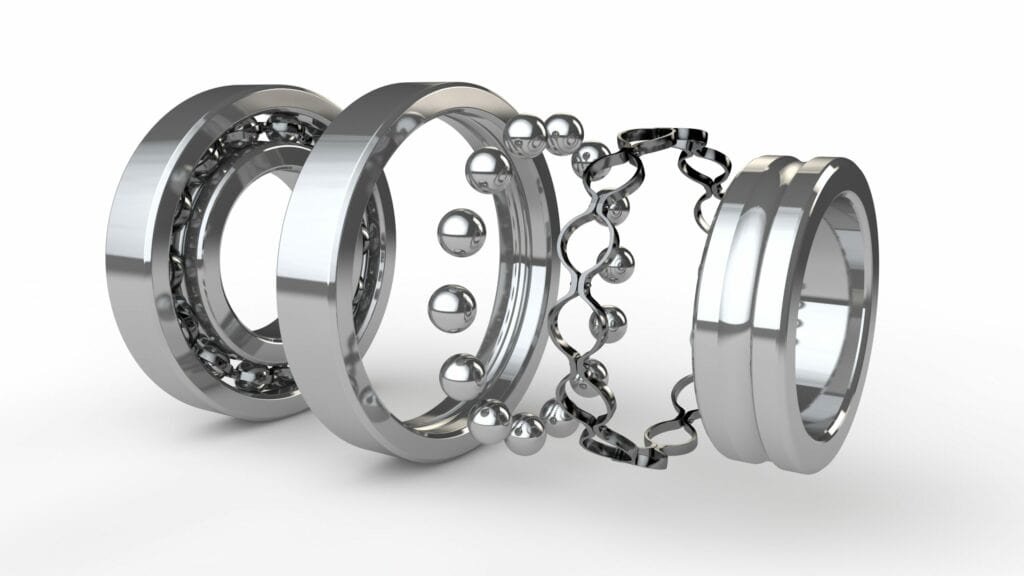
Ball bearing is a part of almost every machine component in your household. It basically helps two adjacent machine components to move or rotate friction-free, making their movement very smooth. However, it is not entirely possible to reduce the friction to zero. Some friction will always occur, especially in the contact area. This friction is bearable and cannot affect the component’s movement.
You may think ball bearing is a single unit component. Well, it’s not. Despite its tiny size, there is a lot going on inside the ball bearing. There are mainly four different components of the ball bearing, including:
| Component | Description |
| Inner ring | This inside part rotates with the shaft. |
| Outer ring | This part is immovable and remains fixed. |
| Steel balls | These are actually the rolling elements that move within the outer and inner rings. They reduce friction. |
| Retainer/cage | It holds the steel balls in place and separates them evenly. |
What is the Function of Ball Bearings?
As mentioned, ball bearings decrease friction between two moving components in machine parts. If the ball bearings are not present, the two parts components start colliding which hinders their motion. Because of the presence of ball rollers the components move frictionless and decrease wear and tear.
There are a number of ways ball bearings help, such as:
Decrease Friction
Whenever any two nearby objects move, they produce friction against each other to dominate one another. This not only affects their motion but also deteriorates their surfac,e leading to wear and tear. The use of ball bearings bring down the friction and ensure smooth operation of each component.
Support Rotating Components
Ball bearings are used in different parts of the machine. For example, they are used in gears, shafts, and wheels of the car. They help make their rotation optimal.
Increase Efficiency
The lesser the friction, the lesser the heat dissipated. All the heat generated from different parts of the machinery makes the machine slow. In the presence of ball bearings, the heat production becomes low. It improves the working efficiency of machines and doesn’t slow their speed. They operate at a better speed with lesser power.
Handle Loads Very Well
It’s great the ball bearings support both axial and radial loads. Axial load is along the axis of the shaft whereas radial load is perpendicular or at 90 degrees to the shaft.
Extend Machine’s Life
By reducing friction, ball bearings also generate less heat. This ultimately increases the life expectancy of the machines and reduces wear and tear noticeably.
What Are The Different Types of Ball Bearings?

Ball bearings have a variety of shapes and types with each having different characteristics that differentiate them from the rest. There are certain factors that determine the types of ball bearings. These are speed, precision needs, and load type. While some are designed for heavy loads, others handle smooth rotation at low speeds.
Some of the common ball bearing types are:
Angular Contact Ball Bearing
These ball bearings can handle both axial and radial loads. Interesting thing about them is that their inner and outer rings are positioned at an angle. It allows the ball bearing to handle rotation at high-speed. Meanwhile, it allows load-carrying in one direction. So, these ball bearings are widely used where high precision is needed for high-speed activity.
Where are they used?
Gearboxes, automotive wheel hubs, pumps & compressors, and machine tool spindles.
Axial Ball Bearings (Thrust Ball Bearings)
As the name indicates, these ball bearings are good at handling axial loads only along the shaft’s axis. Since you cannot use them to carry radial loads, you can use them for applications where the axial load-carrying job is required. They have two rings and a set of balls to rotate between them, making sure the motion is smooth.
Where are they used?
Marine applications, automotive steering systems, industrial machinery with vertical shafts, and aircraft engines.
Deep Groove Ball Bearings
Well, it is one of the most widely used ball bearings. They have a deep raceway in the inner and outer rings to carry radial load fully and axial load to some extent. These ball bearings provide seamless functioning, higher reliability, and low friction. They are versatile and ideal for multiple applications, be it household items or industrial machines.
Where are they used?
Automotive components, fans & pumps, electric motors, and home appliances like refrigerators and washing machines.
Linear Ball Bearings
This type of ball bearing is entirely different from the rest of the types since it carry loads in linear motion and not rotational. Their cage has small steel balls as rolling elements to move along the axis of shaft to make sure the linear motion is without hindrance. They are best to be used for ow friction and high precision applications.
Where are they used?
Industrial automation systems, CNC machines, robotics department, and 3D printers.
Self-Aligning Ball Bearings
They don’t have an inner ring. They have steel ball rolling elements (two sets) and an outer ring that’s spherical in shape. This spherical outer ring allows for the automatic alignment of the balls whenever the shaft is misaligned. This design is not only unique but also reduces the wear and tear of the ball bearings. So, you can use them where there are more changes of shaft misalignment.
Where are they used?
Textile machines, conveyor systems, heavy-duty industrial tools, and machinery used in agriculture.
High-Speed Angular Contact Ball Bearings
These angular contact bearings are designed specifically for extremely high-speed applications to handle axial and radial loads. While doing so, they don’t compromise on the accuracy and smoothness of motion. Their rolling elements are made of ceramic instead of steel, as it considerably reduces friction better than steel balls.
Where are they used?
Medical equipment like MRI machines, aviation systems & aerospace, high-speed machine tools, and racing car components.
All these types provide a different sort of benefit to your bearing needs. So, make sure you choose the right ball bearing types according to your specific application.
What is a Ball Bearing Used for?

There are dozens of applications of ball bearings and they are used in various industries to improve efficiency, reduce friction, handle axial and radial loads, and guarantee smooth operation. The following are the industries where they are used mainly:
| Applications | Description |
| Automotive industry | They are essentially used in bicycles, cars, and motorbikes. You can use them in steering systems, wheel hubs, suspension components, and transmissions for wear reduction and smooth operation. |
| Industrial machinery | Ball bearings are used in production plants and factories in pumps and compressors, conveyor belts, and electric motors to decrease downtime and ensure efficiency. |
| Household appliances | Daily routine appliances like vacuum cleaners, refrigerators, washing machines, and fans have ball bearings for their hindrance-free functioning. Also, they limit the noise production of the moving components. |
| Aerospace & aviation | This industry needs high-precision components for working. Ball bearing in jet engines, control systems, and landing gear solve this issue. They offer high-speed rotation and seamless operations. |
| Medical equipment | They are used in MRI machines, dental drills, and surgical robots because they require accuracy. Ball bearings not only provide accuracy but precision too. |
| Robotic & automation | Ball bearings play a role in robotics and automation industry. They are used in robotic arms, high-speed actuators, and linear movement systems. |
| Sports equipment | Various sports equipment like fishing reels, skateboards, treadmills, and bicycles have ball bearings. They make the movement experience of athletes and children much better. |
| Heavy machinery & construction | You can see their usage in cranes, drilling tools, and excavators for carrying heavy loads under harsh conditions. |
Conclusion
So, if you ask what are ball bearings used for? The simple answer would be that ball bearings are commonly used bearings to support axial and radial loads besides reducing friction to a negligible value. There are multiple types of ball bearings. They are angular contact bearings, linear ball bearings, thrust ball bearings, high-speed angular contact bearings, self-aligning ball bearings, and deep groove ball bearings. So, which one to select? It totally depends on your specific application needs, as each type provides a certain benefit unique to it.
You can see different applications of ball bearings in various industries and household appliances. They are used in sports equipment, medical equipment, heavy machinery and construction, robotics and automation, aerospace and aviation, industrial and household machinery, and the automotive industry.
For more information and queries, contact BYWB Bearing. You can contact us for different types of bearings. We are available 24/7 to assist you!
